 It has been an ongoing dispute within Tulsa County for years and the Tulsa World clearly outlined fundamental differences a Sunday feature story titled “County officials clash on budget” by Kevin Canfield, but there is a bit more to the battle.
An outspoken if not angry conservative, County Assessor Ken Yazel has damned his fellow elected County officials, drawn Tea Party and John Birch Society support by alleging the County budget process is somehow corrupt, improper, and wasteful. Recently, Yazel fired by press release a damning response to a budget cutting press release by County Commission Chairman John Smaligo.
Good thing dueling is illegal in America or these two might well be told, “back to back, ten paces then fire.”
Chairman Smaligo released a directive to cut the County’s budget this year “due to increasing fixed costs, such as health insurance and benefits, coupled with low growth in revenues.” The announcement press release said, “Divisions directors were asked to prepare plans to cut at least five percent near the end of last year. Some divisions have reorganized to eliminate positions and costs, while other divisions are planning for cuts in the near future.” (Click here to read the full release.)
Apparently taking Smaligo’s press release as a challenge Yazel released his own saying, “This is the typical routine for county government officials. They decide not to tell the public about all the money they have, and then plead poor about the fact that one source of revenue isn’t going up as fast as it once did. In the budget process, the Tulsa County Budget Board actually advertises to the public a budget of about $64 million when in fact, taking all funds and fund balances into account, those same elected officials exert influence over $256 million for county operations. (Click here to read the full release.)
County government is the local operational arm of Oklahoma within Tulsa County. When the people vote in approval of funding for the library system, health department, common and technical education; Tulsa County collects funds as state law requires.
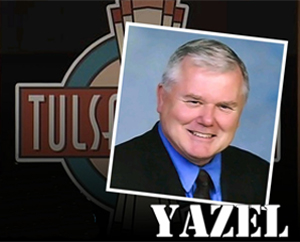 According to Yazel, Tulsa County should determine if the health department can order additional tongue depressors. (Maybe for Yazel that would be a good thing.) What he refuses to acknowledge is that County government cannot legislate only administer as directed by law. The Tulsa County Budget Board has no authority over the City-County Library budget or the City-County Health Department, and other organizations.
Regardless, Yazel continues to encourage citizen protests at County Budget Board meetings and make his case at citizen rallies and meetings.
With Yazel’s encouragement, Don Wyatt, a 9.12 Leader and elected Republican Party official filed protests against four of the budgets approved by the Tulsa County Excise Board in June. They were assigned case numbers by the Oklahoma Supreme Court, but the Court has not yet established the Court of Tax Review to hear the protests.
Wyatt told Tulsa Today, “I am confident that the statutory guidelines were not followed in the adoption of these budgets or in the approval of tax levies subsequently based on these budgets. I believe the taxpayers of Tulsa County have been harmed by excess taxation and by failure to provide full and transparent disclosure of the County’s fiscal condition.”
The statutory guidelines, Wyatt notes, require the Excise Board to approve the budget of the entities protested. Does “approve” equal direct and control? If so that means that every elected school board will be subject to County budget approval so why do we elect school board members if other elected officials control their budgets? What does “approval” require? According to Yazel and Wyatt; close inspection, control and direction of each dollar in each account for each entity.
That has never been the operational standard applied in any part of Oklahoma in the past, but maybe it should. Thus, it is important what the Court of Tax Review may decide.
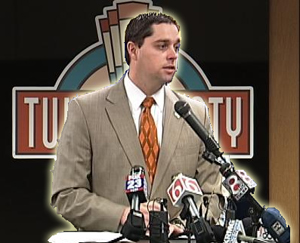 Canfield quotes Smaligo saying, “[Yazel] is purposely ignoring the fact that money for entities such as the library and Health Department are held by the county much like a bank. His claim would be no different than your bank paying its employees directly out of your checking account. Both scenarios would be illegal.”
Wyatt counters to Tulsa Today, “My bank has no such approval role with my checking account. The statutes are explicit and clear about what is supposed to be included in the approval process and the procedures are NOT being followed.”
If detailed oversight, authority and control is required by law; the cost of County government throughout Oklahoma will significantly increase immediately.
If it is a process problem, then the process is public and clearly detailed on the Tulsa County Web Site. If the process should change, it can only do so by state law as approved by the Oklahoma Legislature or voters at the polls or ruled by the court.
The issue then would be what responsibility, authority, and institutional control should remain with the governing bodies of the independent budgeted organizations. For example, should Tulsa County elected officials and staff control the Health Department budget and thus the daily operations of the organization?
 If so, they are going to need a lot more staff and the cost of governing at the County level in Oklahoma will explode. If not, then protesters and those that demand more transparency should direct their rage at the individual entities not Tulsa County.
Wyatt maintains a web site to promote the protest positions, click here to reach BoondoggleBlog.com and links to the actual protests themselves, can be found by clicking here.
County Assessor Ken Yazel’s statutory responsibility is to asses the value of property in Tulsa County at such a level as to meet the requirements and obligations approved by voters of Tulsa County. Your property tax goes, in vast majority, to other organizations with Tulsa County Administration receiving only a fraction of the total.
If Tulsa County Property Tax is too high, it is the collective voter’s fault in approving increased millage rates for specific organizations.
If those organizations are “awash in cash” protests should more properly be directed at the controlling entities or maybe media for not making such organizational riches public – assuming they exist.
However, to blame the collector for fund balances is like blaming crime on a gun.

 Tulsans in House District 71 decided in a primary election Tuesday which candidate will represent them in the general election to replace former-Rep. Dan Sullivan. The winners: Katie Henke for the Republicans and Dan Arthrell for the Democrats, will meet in the general election April 3. What follows is a first person report of a primary debate that featured all candidates.
 When legislators return to the State Capitol next week to convene the 2012 session, lawmakers will be taking another look at a $25 million bond issue they originally authorized in 2009 for the Arkansas River in Tulsa County. That’s after the Council of Bond Oversight voted last week to require
 Anderson’s press release states, "In 2009 legislators were told the $25 million bond project would be matched with $50 million in federal funds. Proponents compared the Arkansas River improvements to those made in Oklahoma City along the Oklahoma River, and claimed a projected economic impact of $2.8 billion and 9,450 new jobs. However, Anderson noted, the federal funding was never approved and the project has never moved forward."
 Anderson failed to mention the State funds are specified to support the continuing development of the Arkansas River Corridor Master Plan. Zink Dam is a part of that plan. River Parks, seeing the Federal delay, is targeting promised state funds for the most critical, cost effective, and immediate improvement possible.
 Further, no mention was made by Sen. Anderson of the American Indian Cultural Center and Museum (AICCM) in Oklahoma City. State funding has already arrived at that project and more is requested for a project that should have been funded in total by Oklahoma Tribal governments.
 Governor Mary Fallin on Friday announced the appointment of Joy Hofmeister to the Oklahoma State Board of Education. She will serve on an interim basis pending Senate confirmation. Hofmeister is replacing Philip Lakin, Jr., who resigned. She will serve the remainder of Lakin’s term through April of 2015 as a member from Congressional District 1.
 Tulsa County Board of Commissioners Chairman John Smaligo announced today that much of his focus this year will be on the budget. Spending cuts are being proposed due to increasing fixed costs, such as health insurance and benefits, coupled with low growth in revenues.
 “I agree with the direction Commissioner Smaligo is proposing. Planning early on will certainly help us in the future and it is good that we started making adjustments last year,” Commissioner Fred Perry said.