Category Archives: Local

River questions muddy waters of decision

By Staff Report    
Monday, 08 October 2007
As Mayor Kathy Taylor said, “Tulsa’s history began with the river, and our future depends on it.”

It’s a fact that the city’s history began at the river, but opponents of the river development proposal – which Tulsa County voters will decide Tuesday, Oct. 9 – don’t seem to think Tulsa’s future is worth a half-penny.  Some are simply against any taxes, any time, while others simply aren’t well informed.

Below, Tulsa Today highlights some critical information – and sheds light on some misinformation – on the issue on the table.

Mistake of Fact #1  My part of Tulsa County won’t be helped by developing the Arkansas River.

Answer:  All economy is regional.  Money flows irrespective of political boundaries.  On any given day; people from Kansas, Arkansas, Missouri, and throughout Oklahoma visit Tulsa for business, shopping and entertainment.  They bring money.  They spend money and benefit the economy and each individual within the community.  For more:  Read the Arizona State University analysis of the Phoenix Metropolitan Area by clicking here, or review the Regional Science Association material by clicking here.

Mistake of Fact #2  Private developers should build river infrastructure.

Answer:  Only local governmental authority can gain the environmental permits necessary to repair and restore the Arkansas River.  Government typically builds infrastructure that allows private business to flourish – in this case, much like a highway, private development will occur on both sides of the Arkansas River once there is water in the river.

Mistake of Fact #3  Vision 2025 paid for dams, and that program has overage enough to build all that is needed.

Answer:  “Vision 2025” has money for Arkansas River restoration, but it was always intended that Federal money would match this local grant.  Further money is also available in Tulsa County’s “4-to-Fix” program and the City of Tulsa’s “3rd Penny” program.  Regardless, it is not enough.  The “overage” that critics asserted for a time was proven to be a $200 million mistake made by those same critics – see Myths of river money (August 12) by clicking here.

Mistake of Fact #4  Sales taxes should not be used by Tulsa County for infrastructure development.

Answer:  The alternative is property taxes that would be much more onerous upon Tulsa residents.  Over 20 percent of sales taxes are paid by visitors; thus, the tax will be smaller when spread over a larger number of people, many who work in Tulsa, but live outside the County.  This 0.4 tax equates to a dime a day – even bums have that.  There is also a low-income and senior rebate for those who qualify that equals the amount they are anticipated to pay annually.
 
Mistake of Fact #5  They should fix the streets first.

Answer:  This is a Tulsa County – not City of Tulsa — proposal that will grow the economy by providing resources to each municipality to enable more street repair in that area.  Each city should prioritize streets, but river development and restoration is a substantial infrastructure improvement no city could do on its own.  Tulsa County roads are in great shape, but if you don’t like the way your city street rides – call your city’s mayor.

Mistake of Fact #6  It’s not clear what this proposal is actually for.

Answer:  A “yes” vote on this issue will help build new low-water dams at Sand Springs and Jenks and repair the one at 31st Street and Riverside.  The three dams will work together to maintain three lakes and keep water in the river year-round.  Although there is water in the river daily as Keystone dam generates electricity, it doesn’t reach Tulsa until about 10 p.m. before disappearing by about 3 am – the dams will pool that water and release it gradually over the daylight hours.  This proposal will restore a living river system in Tulsa.

Mistake of Fact #7  The Arkansas River stinks!

Answer:  Part of that smell is because water spreads out between sandbars, gets trapped and becomes stagnant.  This proposal will channel that water between lakes so that it keeps moving – which will reduce the bad odor.

Mistake of Fact #8  What about the refinery smell?

Answer:  The refineries have announced that they plan to implement significant improvements to beautify their areas and reduce odor.  That work is currently under way.

Mistake of Fact #9  There is nothing in this proposal for me!

Answer:  Tulsa is land-locked and surrounded by other municipalities.  Our only choice to grow as a city is to develop areas that have long been ignored.  With this infrastructure effort, the river will become attractive to developers – and they, in turn, will attract private businesses that will grow the economy and generate revenue for the City of Tulsa that will help keep your taxes low.  That will help everyone.

Mistake of Fact #10  Should the County do this – why not let each city do their own?

Answer:  The U.S. Corps of Engineers is working as a full partner with Tulsa County.  They report that the odds are much better of receiving the $50 million Federal funding authorized for the Arkansas River if there is one local entity coordinating multiple municipalities.  This is a fulfillment of the Arkansas River Corridor Master Plan to restore the river throughout Tulsa County.

Mistake of Fact #11  If there is Federal money available, why approve this tax?

Answer:  All Federal money requires local matching funds for major projects.  Some money has been set aside in Vision 2025 and 4-to-Fix the County to help, but the work on the river can be done now and, when received, the Federal money will end the tax early.

Mistake of Fact #12  Is this that “Channels Plan” to build apartments in the middle of the river?

Answer:  No – that was a private plan.  This is a part of the Arkansas River Corridor Master Plan developed over four years by an advisory group of over 30 organizations committed to the environmentally proper growth and development of Tulsa County natural resources.  More than 60 public meetings were held and this, more than any other proposal in history, is the people’s plan.

Need more information?  Feel free to call the “Make Our River Happen” office at 749-7483, or check their Web site at www.OurRiverYes.com.  Other sources include the newspaper Web site at www.TulsaWorld.com.  To see video click here.
 
As University of Oklahoma President David Boren said recently, Arkansas River development in Tulsa will benefit the state’s economy by creating “the kind of communities that will become homes of choice … I can see the river and the parks along the river becoming to Tulsa what Central Park has become to New York City.”

Enjoy previously posted stories on Arkansas River Development.

Tulsa can recover the Arkansas River (June 25)

Myths of river money (August 12)

Tulsa senator thinks river tax is all wet (September 6)

Conservatives should support river infrastructure (September 17)

Congressman Sullivan supports river restoration (September 21)

There are also two pieces in the Editorial Section that mention the River issue as part of other issues.

Rifting Tulsa this and river that (August 20)

Tulsa politics and propriety in punditry (September 24)

Last Updated ( Monday, 08 October 2007 )
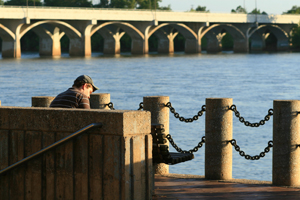
Key Corps of Engineers team member addresses Arkansas River development process

ArkansasRiverTulPark1A key member of the Tulsa District Corps of Engineers team responsible for creating the Arkansas River Corridor Master Plan is speaking out about the specifics of the proposed river development package, up for vote in Tulsa County on Tuesday, Oct. 9.

As a project manager for the Tulsa District Corps of Engineers, Cynthia Kitchens manages “general investigation projects” in the Tulsa District, as well as reallocation studies and land sales.  But what, exactly, is the Tulsa District, and what does it do?

Continue reading →

Sen. Wilcoxson to discuss national report results on Oklahoma education

By Staff Report    
Thursday, 27 September 2007
Senate Education Co-Chair Kathleen Wilcoxson will visit the Tulsa Metro Chamber of Commerce on Tuesday, October 2, to share the results of a recent study by the U.S. Chamber of Commerce.  The report, called “Leaders and Laggards,” gave Oklahoma an overall grade of “D”.  Wilcoxson, R-Oklahoma City, said it was important for community, business and education leaders to know what is in the report, and what others are saying about it.

“Burns Hargis, Vice Chairman of Bank of Oklahoma, called this report a knife in the heart of our economic development efforts,” Wilcoxson said.  “Whether you take issue with the findings or not, if you think competing states won’t hesitate to use this information against us, you’re dead wrong.”

Wilcoxson said Oklahoma was one of only 10 states to receive an “F” in academic achievement, and one of only two states to receive an “F” for truth in advertising about public education.

“While the State Department of Education continues to praise the strides being made in our state, the facts paint a different picture.  For example, the latest ACT results show that only 17 out of 100 Oklahoma graduates who took the ACT were ready for college in English, Math, Science and Social Studies,” Wilcoxson said.  “My guess is most people have no idea how poor a job we’re doing in preparing our young people for college and for the workforce.”

Wilcoxson said it was vital for parents, business, community leaders and educators to take an honest look at the problems in the system and find new, creative solutions.

“We cannot afford to gloss over the truth.  Having the facts is an important first step,” Wilcoxson said.  “With enough political will, we have the opportunity to be a model state in moving from a laggard to a leader in education.”

Wilcoxson will make her presentation at 2 p.m. on October 2 at the Tulsa Metro Chamber at 2 West Second Street.  For more information, call 405-521-5618.

Wilcoxson was born in Lawton, Oklahoma, and grew up in Owasso, Oklahoma.  She now lives in Oklahoma City with her husband Lynden Wilcoxson, and they have one daughter and son-in-law, Stacy and Jeff Salem of Noble.  Her husband is a retired school teacher and counselor and is now actively involved in the Oklahoma Water Color Association as state president.  She and Lynden attend the Bridge Assembly of God in Mustang, Oklahoma, where she is an adult Sunday school teacher, and he sings in the choir.

Senator Wilcoxson taught school since 1970 and was appointed by President Ronald Reagan to the National Advisory Council on Adult Basic Education in 1982 where she served four years. She was selected OKC Teacher of the Year in 1990, and she also earned her doctorate in curriculum and instruction from Oklahoma State University.

Wilcoxson was elected to the Oklahoma State Senate in 1996 and was re-elected in 2000 and 2004.  She represents Moore, So OKC, Mustang and Yukon.

She is a member of the Moore, Mustang, South OKC and Greater OKC Chambers of Commerce.  She serves on the Board of trustees for the Oklahoma Foundation for Excellence which honors outstanding high school students and teachers.  

Last Updated ( Thursday, 27 September 2007 )

Congressman Sullivan supports river restoration

By Staff Report    
Friday, 21 September 2007
Congressman John Sullivan (R-OK 1 Dist) held a press conference at the River Park Festival Grounds today to support and encourage others to support the River Plan coming to a vote October 9.  The following is the full text of his remarks:

I am proud to represent the First District of Oklahoma in the U.S. House of Representatives.  I was born and raised in Tulsa, am a fourth generation Oklahoman, and the proud father of five children.  Those of us who live in Tulsa know what a great city it is – to work, to play, to grow up and to raise a family.  That is why investing in Tulsa’s future is so important.  When they grow up, I want my children, and their children, to be able to make a home here – to live and thrive in this great community.  In order for this to happen, it is important that we invest in our great city now.

The Arkansas River Development Project will not only bring economic expansion, visitors and growth to Tulsa, but to the entire region.  Planned river development in Sand Springs, Jenks, Bixby and Broken Arrow will provide those areas with beautiful, pedestrian friendly space along the Arkansas River.  It really is an asset to the entire area.

Other American cities have been successful in their riverfont projects, spurring billions of dollars of economic investment into their communities.  To the south in Forth Worth, Texas, my friend Congresswoman Kay Granger, along with other public and private entities, is helping bring millions of dollars of economic development along 88 miles of their waterfront.  Now it is Tulsa’s turn.

I will do my part in working diligently with the Oklahoma delegation to secure federal funding for this project.  The Water Resources Development Act, which contains $50 million in funding for the ecosystem restoration, recreation and flood damage reduction components of the Arkansas River Corridor Master Plan, passed the House on August 1 and will hopefully be brought up in the Senate soon.  My colleague and friend Senator Jim Inhofe has been working hard to help get this legislation passed and these funds secured.  He has worked tirelessly to ensure these basic infrastructure needs get authorized.  Even after this authorization is secured, we will still need to work on the appropriations process for funding.  In addition, the City of Tulsa has received the generous gift of $117 million in private donations – the largest private donation for a city-county project in state history, making this a true public-private partnership.  This covers one-third of the cost of the Arkansas River Development project.  The citizens of Tulsa will be forever grateful to these generous contributors for the positive, lasting impact they will make on our city.

To my friends and colleagues who have stood in opposition to this River Development project, I say to you:  the time for Tulsa is NOW.  For too long, our region has envied our neighbors living in our state’s capital, who have shaped and taken advantage of their natural resources to bring growth and economic development to the city.  But now Tulsa stands with a real proposal for economic success on our table and we have to consider the benefits the entire area will see.

In this, you have not seen anyone debate the fact that we need to do something with the Arkansas River.  Everyone supports the growth of this great opportunity; we simply differ on how we do it.  INCOG’s Arkansas River Development plan, combined with the generous private gift and the interest these projects have generated will help us reach the important benchmarks for private verses public investment.  It is important that there is a two to one ratio of private funds to public funds.  There is the potential for a real dollar impact for our public dollar investment.

This once in a lifetime opportunity will allow private and public entities to work together to produce a reiverfount which will bring pride to our city.  The Arkansas River Development Project will help keep jobs and people in Tulsa and is an investment for our future.  Tulsa is investing in itself, and in Oklahoma.  In past decades we have always thought our next great thing was just over the horizon, when we see now it was right in our own backyard, in OUR River.  I’ve lived in Tulsa for a long time.  I’m tired of hoping something would happen.  It is time to make something happen.

Vote YES October 9 for OUR RIVER.
Last Updated ( Friday, 21 September 2007 )

Conservatives should support river infrastructure

By David Arnett, Publisher    
Monday, 17 September 2007
Editorial Analysis:  As tax limits liberty and money is more powerful in individual pockets than when seized by government; conservatives typically oppose tax increases with the exceptions of national defense and infrastructure   Thus, Tulsa County conservatives should support the Arkansas River Corridor Master Plan as the most compelling infrastructure springboard ever considered for the metropolis of Tulsa.

The package voters could approve October 9 is a “bricks & mortar” list of physical improvements creating a living river system, the first major improvements we could see in three years.  It is a realistic fundamental package that makes viable, for the first time in history, land and water in the center of Tulsa County for multiple public and private development throughout several cities.
The plan evolved from over 60 public meetings and four years of study by professionals from multiple disciplines.  As all economy is regional, the benefits of river development will cascade throughout northeastern Oklahoma.  River development has profited the people of every community that has ever undertaken the task, so it boils down to the question:  Do you want the Arkansas River developed or not?

Opponents of the funding package agree the plan is good – they just don’t want to pay for it, but is less than 10 cents a day too much a burden to fix the Arkansas River in Tulsa County?  The tax also includes a “senior rebate” and a “low-income rebate.”  It will add money to schools and multi-municipalities as previously unusable land becomes productive and desirable.  Once the projects listed are built, the tax will end.
Tulsa County officials have thoroughly investigated alternative methods of financing and this 0.4 of one penny for seven years or less is the best option as it provides the largest base.  Should Federal matching funds be received ($50 million is under consideration) or revenue exceed the amount needed, the tax will end early.  In addition to the public funds, over $117 million in private donations are guaranteed from local donors to add to the package.  Private development by the billions is expected from multiple developers as land becomes available.

It is government’s job to provide public infrastructure so private development can build projects to grow a robust economy.  Just like a main street or highway, the 42 miles of the Arkansas River in Tulsa County provides opportunity for growth.

Hiding behind the “No-Tax-Never” crowd, a few officials including the Mayor Wade McCaleb of Broken Arrow and Oklahoma Senator Randy Brogdon have admitted they favor tax packages for their respective provincial preferences while criticizing the river plan as “not enough butter on their bread.”

Less honorable critics have tried to confuse the issue by claiming the City of Tulsa is incompetent or inattentive to street repair so this Tulsa County package should not be approved.  Tulsa County roads are maintained at a much higher level than city streets.  Confusing levels of government is not new, but evil as the Bible says, “God is not the author of confusion — ironic in that the most politically self-righteous are most culpable of the tactic.

Regardless, the City of Tulsa is landlocked.  Had Tulsa followed Oklahoma City’s example and annexed every cow pasture of additional land within reach, we would have a larger base from which to grow.  Even within the last few years, the Tulsa City Council failed to annex the Tulsa exit of the Turner Turnpike.

The point on river restoration and development is that this is a “bricks and mortar” package that will build specific infrastructure and make previously undesirable land and water in the center of our metropolis viable for development in multiple municipalities.  So again and to the bottom line of all debate on this proposition before the people October 9, do you want the 42 mile Arkansas River Corridor Master Plan as developed over 4 years and 60 public meetings to be built?

Leading up to that October 9 vote, Tulsa Today will answer reader questions.  If you have a question, please write using our “contact” form or e-mail direct to editor@tulsatoday.com.

Reader E-Mail:
Jack Pauling wrote: Let the citizens truly decide.  In October, put the bond issue for streets on the same ballot with the river development.  Then the people can decide. As it is, we get the river tax now and won’t even hear about the bond election for streets until next year.  By then, citizens will be so "taxed" with Vision 2025 and the river that they will surely turn down another self tax.  Not because our roads don’t need fixing, we just won’t be able to afford them.

Tulsa Today:  As was written above, the street issue is a City of Tulsa issue and river development is a Tulsa County issue.  There are many questions about how the City of Tulsa spends an annual $560 million operating budget – to say nothing of their capital improvement budget.  Vision 2025 was a specific infrastructure package that has been operated transparently and properly as the specific propositions approved by voters directed.  Tulsa County’s annual $60 million operating budget is considered by many to be a bargain for the number and range of services provided.

Glenda wrote:  How many bridges in Tulsa County would 1/2 cent tax increase fix in 5 yrs?  Would bridge re-construction help everyone in the county that is to pay?  Would being updated on bridges and making safe driving across our county be a attraction?

Tulsa Today:  Again, Tulsa County bridges receive inspection and repair as needed.  That effort also involves the State of Oklahoma and, as a state issue, deserves and is receiving increasing attention.

Glenda continued:  Isn’t this tax in part to be used to make new bridges to only a selected travel for selected income?

Tulsa Today:  No.

Glenda continued:  Do we not have other parks to visit and don’t we now have such wildlife living on the banks that we don’t need to disturb?  Could we not use this as a true attraction that people will drive to Tulsa to spend 2 or 3 days to visit our city?

Tulsa Today:  Yes, there are other parks and many reasons to visit Tulsa and Northeast Oklahoma.  The Arkansas River Corridor Master Plan will enhance and restore habitat.  Currently many parts of the river are inaccessible and, in come cases, dangerous to visit.  This plan will address those issues and provide more public access and private development.  That development will draw people (visitors and locals) and sales tax money gathered at those locations will go to the municipalities which can then be spent on enhanced public services as local officials direct.

Glenda continued:  The Vision 2025 was perfect and suits everyone, this will have people coming in now we need the other 2 nights of travel for these people to stay.  Going to a middle of a River I don’t believe will, unless it has great attractions people will come with 1 yr olds and up and spend time and money in Tulsa.

Tulsa Today:  Family with young children enjoy areas provided now and that usage will increase as more public and private areas are built.  There is no building in the middle of the river proposed in this plan.  There are pedestrian bridges across the river and public use areas on both sides.

Glenda continued:  I don’t like seeing kids used in the advertising for this PROJECT.  This is not a kid issue that they can comprehend and have a concept of money and long term.  A 3 or 4 yr old will only repeat not comprehend.

Tulsa Today:  We understand that the young people shown are older than you suggest.  The commercials promoting the river are produced by the Our River Yes group and seek to convey what is for many the most compelling reason for river development – for the next generation of Tulsans to enjoy with pride as they grow.

For more information, click here for an overview of river development, click here for the entire Arkansas River Corridor Master Plan, click here for River Parks, click here for a previous story on funding options, click here for an interview with river critic Oklahoma Senator Randy Brogdon, click here for the river opposition site, and click here for the Our River Yes site.
Last Updated ( Thursday, 20 September 2007 )