 NASA’s Voyager 1 spacecraft has entered a new region at the far reaches of our solar system that scientists feel is the final area the spacecraft has to cross before reaching
interstellar space.
Scientists refer to this new region as a magnetic highway for charged particles because our sun’s magnetic field lines are connected to interstellar magnetic field lines. This connection allows lower-energy charged particles that originate from inside our heliosphere — or the bubble of charged particles the sun blows around itself — to zoom out and allows higher-energy particles from outside to stream in. Before entering this region, the charged particles bounced around in all directions, as if trapped on local roads inside the heliosphere.
The Voyager team infers this region is still inside our solar bubble because the direction of the magnetic field lines has not changed. The direction of these magnetic field lines is predicted to change when Voyager breaks through to interstellar space. The new results were described at the American Geophysical Union meeting in San Francisco on Monday.
"Although Voyager 1 still is inside the sun’s environment, we now can taste what it’s like on the outside because the particles are zipping in and out on this magnetic highway," said Edward Stone, Voyager project scientist based at the California Institute of Technology, Pasadena. "We believe this is the last leg of our journey to interstellar space. Our best guess is it’s likely just a few months to a couple years away. The new region isn’t what we expected, but we’ve come to expect the unexpected from Voyager."
Since December 2004, when Voyager 1 crossed a point in space called the termination shock, the spacecraft has been exploring the heliosphere’s outer layer, called the heliosheath. In this region, the stream of charged particles from the sun, known as the solar wind, abruptly slowed down from supersonic speeds and became turbulent. Voyager 1’s environment was consistent for about five and a half years. The spacecraft then detected that the outward speed of the solar wind slowed to zero.
The intensity of the magnetic field also began to increase at that time.
Voyager data from two onboard instruments that measure charged particles showed the spacecraft first entered this magnetic highway region on July 28, 2012. The region ebbed away and flowed toward Voyager 1 several times. The spacecraft entered the region again Aug. 25 and the environment has been stable since.
"If we were judging by the charged particle data alone, I would have thought we were outside the heliosphere," said Stamatios Krimigis, principal investigator of the low-energy charged particle instrument, based at the Johns Hopkins Applied Physics Laboratory, Laurel, Md. "But we need to look at what all the instruments are telling us and only time will tell whether our interpretations about this frontier are correct."
Spacecraft data revealed the magnetic field became stronger each time Voyager entered the highway region; however, the direction of the magnetic field lines did not change.
 "We are in a magnetic region unlike any we’ve been in before — about 10 times more intense than before the termination shock — but the magnetic field data show no indication we’re in interstellar space," said Leonard Burlaga, a Voyager magnetometer team member based at NASA’s Goddard Space Flight Center in Greenbelt, Md. "The magnetic field data turned out to be the key to pinpointing when we crossed the termination shock. And we expect these data will tell us when we first reach interstellar space."
Voyager 1 and 2 were launched 16 days apart in 1977. At least one of the spacecraft has visited Jupiter, Saturn, Uranus and Neptune. Voyager 1 is the most distant human-made object, about 11 billion miles (18 billion kilometers) away from the sun. The signal from Voyager 1 takes approximately 17 hours to travel to Earth. Voyager 2, the longest continuously operated spacecraft, is about 9 billion miles (15 billion kilometers) away from our sun. While Voyager 2 has seen changes similar to those seen by Voyager 1, the changes are much more gradual. Scientists do not think Voyager 2 has reached the magnetic highway.
The Voyager spacecraft were built and continue to be operated by NASA’s Jet Propulsion Laboratory, in Pasadena, Calif. Caltech manages JPL for NASA. The Voyager missions are a part of NASA’s Heliophysics System Observatory, sponsored by the Heliophysics Division of the Science Mission Directorate at NASA Headquarters in Washington.
For more information about the Voyager spacecraft, visit: http://www.nasa.gov/voyager and http://voyager.jpl.nasa.gov.
Illustration – The Sun’s Southern Wind Flows Northward: This artist’s concept shows how NASA’s Voyager 1 spacecraft is bathed in solar wind from the southern hemisphere flowing northward. This phenomenon creates a layer just inside the outer boundary of the heliosphere, the giant bubble of solar ions surrounding the sun. If the outside pressure were symmetrical, the streams from the sun’s northern hemisphere above the plane of the planets would all turn northward and the streams from the southern hemisphere would all turn southward.
However, the interstellar magnetic field presses more strongly on the boundary in the southern hemisphere, forcing some of the solar wind from the south that otherwise would have gone southward to be deflected northward to where Voyager 1 is. On July 21, 2012, the magnetometer instrument indicated that Voyager 1 had entered a region where the wind is from the southern hemisphere. Scientists interpret this to mean that the spacecraft is in the final region before reaching interstellar space because the southern wind streams have to flow out and around all of the northern wind to reach Voyager 1’s location.
Image credit: NASA/JPL-Caltech

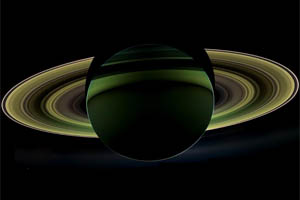 Just in time for the holidays, NASA’s Cassini spacecraft, in orbit around Saturn for more than eight years now, has delivered another glorious, backlit view of the planet Saturn and its rings.
 Republican Jim Inhofe and Democrat Barbara Boxer released dueling videos to their respective audiences at the UN Climate Change Conference in Doha, Qatar, Thursday.
 The world stopped getting warmer almost 16 years ago, according to new data released last week and as reported by the UK’s Daily Mail.
 The University of Texas at Austin says it has investigated and found no evidence of research misconduct in a study that found adult children from “gay” families are “more apt to report being unemployed, less healthy, more depressed, more likely to have cheated on a spouse or partner, smoke more pot, had trouble with the law…” than children from traditional mom-and-dad households.
 Regnerus wrote, “The differences, it turns out, were numerous. For instance, 28 percent of the adult children of women who’ve had same-sex relationships are currently unemployed, compared to 8 percent of those from married mom-and-dad families. Forty percent of the former admit to having had an affair while married or cohabiting, compared to 13 percent of the latter. Nineteen percent of the former said they were currently or recently in psychotherapy for problems connected with anxiety, depression, or relationships, compared with 8 percent of the latter. And those are just three of the 25 differences I noted.”