
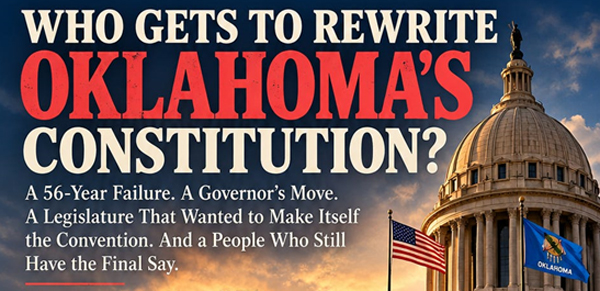
Analysis: Oklahoma may be approaching one of the most consequential constitutional debates since statehood and the immediate question sounds simple: Should Oklahoma hold another constitutional convention?
That question conceals several others that may be even more important. Who possesses the authority to put that question before the voters? Who should serve as delegates if the people approve a convention? Should sitting legislators be permitted to appoint themselves to the body empowered to propose a rewriting of the Constitution under which those same legislators exercise power? And how much representation should Oklahoma’s 77 counties have in a process that could fundamentally alter state government?
For those of us who favor smaller government, lower taxation and less federal, state and local regulatory intrusion into our daily lives, these aren’t academic questions. A constitution is supposed to restrain government.
The people who exercise governmental power should therefore be extraordinarily cautious about giving themselves control over the process by which those restraints can be rewritten. And Oklahoma’s history offers an important reminder:
The politicians already holding state legislative office did not write Oklahoma’s original Constitution. The people elected delegates specifically to do that job.
The Constitutional Requirement Oklahoma Ignored
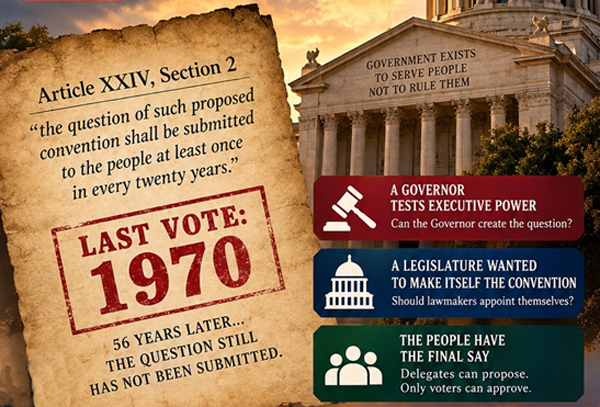
Article XXIV, Section 2 of the Oklahoma Constitution contains language that is remarkably difficult to misunderstand. It provides that: “the question of such proposed convention shall be submitted to the people at least once in every twenty years.”
The operative word is shall. Not may. Not whenever the Legislature finds it convenient. Not whenever political leadership decides the time is right.
Oklahoma voters were last presented with the required constitutional-convention question in 1970. They rejected it overwhelmingly. Then the clock apparently stopped. Twenty years passed. Then thirty. Then forty. Then fifty. Today Oklahoma has gone 56 years without submitting the question again.
The neglect becomes even more remarkable because Oklahoma voters were asked in 1994 whether they wanted to eliminate the twenty-year requirement. They declined to do so.
The constitutional command survived. State Government simply failed to follow it. That should concern Oklahomans regardless of whether they support or oppose a constitutional convention. A constitutional provision cannot reasonably be treated as binding only when government finds it convenient.
Gov. Stitt Decides to Act
Gov. Kevin Stitt has now attempted to break the 56-year stalemate. Stitt issued a proclamation directing that State Question 848 be placed before Oklahoma voters at a special statewide election on April 6, 2027. The basic question is whether Oklahoma should begin the process contemplated by Article XXIV and call a constitutional convention.
Stitt’s underlying argument has considerable force. The Constitution says Oklahoma voters shall receive this opportunity at least every twenty years. They haven’t. Someone failed to do their job. But recognizing a constitutional violation and possessing constitutional authority to correct it are two different things. That distinction may ultimately determine whether SQ 848 ever reaches the ballot.
Can the Governor Create the Question?
Oklahoma’s Constitution unquestionably gives the Governor certain authority concerning special elections. Article V, Section 3 provides for elections on measures referred to the people and permits either the Legislature or Governor to order a special election under the circumstances described there.
But there is an important difference between: calling the election at which an already lawful state question will be decided; and, originating the state question itself. That distinction presents a serious separation-of-powers question.
Oklahoma’s constitutional structure does not ordinarily allow one branch of government to acquire another branch’s authority simply because the second branch refuses to act.
If the Legislature neglected Article XXIV for 56 years, that may constitute one constitutional problem. If the Governor lacks authority to originate the convention question himself, his attempt to remedy that neglect may constitute another. Two branches can be wrong simultaneously.
Limited government requires us to remember that principle even when we agree with the objective one branch is trying to accomplish. Government officials do not acquire additional constitutional authority merely because they believe their objective is desirable.
The McBride Challenge
Former Republican state Rep. Mark McBride of Moore has now taken the dispute directly to the Oklahoma Supreme Court. The Sooner Sentinel has obtained McBride’s September 8, 2026 brief supporting his application for original jurisdiction, extraordinary declaratory judgment and extraordinary injunctive relief in Oklahoma Supreme Court Case No. 124381. The filing names Gov. Kevin Stitt, Secretary of State Benjamin Lepak and State Election Board Secretary Paul Ziriax as respondents.
McBride’s argument is more developed than simply claiming that Stitt cannot call a special election. At its core, his case asks a fundamental separation-of-powers question: Can a Governor remedy the Legislature’s failure to comply with a constitutional command by exercising authority the Constitution does not expressly give the Governor? McBride says no.
Mandatory Does Not Necessarily Mean Self-Executing
Article XXIV, Section 2 contains the provision at the center of this entire controversy: “the question of such proposed convention shall be submitted to the people at least once in every twenty years.”
Oklahoma has plainly failed to meet that timetable. The last constitutional-convention question was submitted in 1970. Gov. Stitt relies upon that constitutional command in defending his decision to place SQ 848 before voters. His office says Oklahoma’s Constitution requires the people to receive the opportunity at least every twenty years and that, after 56 years without such a vote, the Governor acted to fulfill that neglected obligation.
McBride does not solve that 56-year problem by pretending the word “shall” isn’t there. Instead, his brief makes a subtler argument: a constitutional requirement can be mandatory without being self-executing. McBride argues that Article XXIV’s twenty-year provision does not specify who must initiate the process, what mechanism must be used, at what election the question must appear, or what ballot language must be employed. Because those details are absent, he contends the provision requires legislative implementation before it can be carried into effect.
That distinction may become one of the central questions before the Court. The Constitution commands that something be done. But who has constitutional authority to do it?
McBride Says the Process Must Begin With Law
McBride reads Article XXIV, Section 2 together with Oklahoma’s broader constitutional allocation of legislative authority. The provision states that no convention shall be called unless “the law providing for such convention” has first been approved by the people.
McBride argues that the first necessary step is therefore legislation establishing the convention process, followed by voter approval. He contends that no constitutional provision or statute independently authorizes the Governor to originate the convention referendum.
The filing also points to Oklahoma’s historical practice. McBride maintains that previous attempts to call constitutional conventions proceeded through legislation or the initiative process rather than unilateral executive action.
His brief specifically invokes a 1970 Oklahoma Attorney General opinion addressing the constitutional-convention process and quotes it for the proposition that the Legislature must first provide by law for the convention before that law is submitted to the people for approval.
A Separation-of-Powers Case
McBride therefore frames the controversy not primarily as a dispute over whether Oklahoma should hold a constitutional convention, but over which branch possesses the power to begin the process.
His second proposition alleges that Stitt exceeded the powers constitutionally granted to Oklahoma’s chief executive. The brief relies upon Oklahoma’s separation-of-powers provisions and decisions restricting executive officials from exercising powers assigned to another branch. McBride argues that the Governor cannot acquire legislative authority simply because the Legislature failed to perform its own constitutional responsibility.
That creates an unusual constitutional confrontation. The Legislature may have failed for 56 years to carry out a constitutional command. But McBride’s position is that legislative failure does not enlarge executive power. In other words, one constitutional problem cannot necessarily be cured by creating another.
McBride Challenges More Than the Ballot Question
The filing also challenges portions of Stitt’s implementation of the convention proposal. McBride argues that the Governor exceeded his authority by creating a nine-member Oklahoma Constitutional Convention Commission charged with studying and recommending procedures for a possible convention. He also challenges the Governor’s direction to the Secretary of State concerning preparations for the April 6, 2027 special election, arguing that Oklahoma law places supervision of elections with the State Election Board.
The brief summarizes its separation-of-powers allegations by accusing the Governor of circumventing the Legislature, appointing an advisory commission concerning a process McBride says belongs to the Legislature, and directing executive officials to arrange an election without sufficient statutory authority.
An Executive Order Is Not a Law
McBride’s third proposition goes directly to the legal force of the Governor’s actions. He argues that an executive proclamation or executive order cannot substitute for legislation where the Constitution requires legal authority that the Governor does not independently possess. Citing Oklahoma precedent, the brief contends that executive orders do not acquire the force of law merely because the Governor signs them.
McBride therefore asks the Oklahoma Supreme Court to assume original jurisdiction, declare Stitt’s Executive Proclamation and Executive Order 2026-31 contrary to the Oklahoma Constitution, and issue appropriate injunctive relief. The supporting brief itself notes that the specific writ requested is contained in a separate pleading, an important distinction because the document obtained by the Sooner Sentinel is the supporting brief rather than that separate application or petition.
McBride Says He Supports a Convention
There is another important distinction. McBride says he is not opposed to Oklahoma holding a constitutional convention. His objection is to the manner in which SQ 848 reached the ballot.
“I’m not against the convention at all,” McBride told reporters. “I’m not against it, but what I’m saying is it’s got to be done right.” Contemporary reporting likewise describes his challenge as directed at Stitt’s authority rather than at the concept of a convention itself. That distinction matters because the Court does not necessarily have to decide whether Oklahoma needs a constitutional convention. It must determine who has constitutional authority to initiate the process.
The Supreme Court Takes the Next Step
The case is now moving beyond McBride’s opening filing. As of September 11, the Oklahoma Supreme Court reportedly directed Gov. Stitt, Secretary of State Lepak and State Election Board Secretary Ziriax to respond by September 28. The Court also indicated that it does not presently expect oral argument, meaning the dispute may be decided from the written submissions.
That makes the respondents’ forthcoming briefs particularly important. McBride has now laid out his theory: Article XXIV imposes a mandatory duty, but the twenty-year provision is not self-executing; implementing legislation is required; and executive power cannot substitute for legislative action.
Stitt’s publicly stated position is considerably simpler: the Constitution says Oklahomans are supposed to receive this opportunity at least every twenty years, they have been denied it for 56 years, and his action fulfills that constitutional obligation.
The Oklahoma Supreme Court may therefore have to confront a constitutional problem created not by government acting too frequently, but by government failing to act for more than half a century.
The question is no longer whether Oklahoma ignored Article XXIV’s twenty-year command. The harder question is: When one branch of government fails for decades to perform a constitutional duty, does another branch acquire authority the Constitution never expressly granted it? For a system built upon divided governmental power, the answer could reach considerably further than State Question 848.
Then Comes the Bigger Question: Who Are the Delegates?
Even if Oklahoma voters eventually approve a constitutional convention, that doesn’t answer the next critical question: Who gets to sit in the room?
During the 2026 legislative session, the Oklahoma House advanced HJR 1089, a proposal concerning the constitutional-convention process. The resolution proposed making the members of the existing Oklahoma Legislature the delegates to the convention. That would mean Oklahoma’s 101 state representatives and 48 state senators would become the constitutional delegates.
The measure passed the House but subsequently stalled in the Senate. The Senate’s official records show HJR 1089 reached its Rules Committee before the process stopped. Whatever the institutional disagreements between the House and Senate, the more fundamental question deserves attention: Why should the Legislature appoint itself to a constitutional convention in the first place?
A legislator is elected to legislate under the existing Oklahoma Constitution. A constitutional delegate is selected for the extraordinary purpose of considering changes to the fundamental document that creates, empowers and restricts that Legislature. Those are not necessarily the same job.
Oklahoma Didn’t Do It That Way the First Time
When Oklahoma prepared for statehood in 1906, there was no Oklahoma Legislature. There couldn’t have been. Oklahoma wasn’t yet a state. Congress passed the Oklahoma Enabling Act of 1906, establishing the process by which Oklahoma and Indian territories could form a state government. And the people elected their constitutional delegates.
The election occurred on November 6, 1906, and the delegates assembled at Guthrie on November 20 to begin writing the document that eventually became the Oklahoma Constitution. The original allocation is especially interesting in light of today’s representation debate.
Congress established 112 delegates:
55 from Oklahoma Territory,
55 from Indian Territory, and
2 from the Osage Reservation.
That initial allocation was geographical. Congress did not simply take the combined population of the future state and divide all 112 seats through one statewide mathematical population formula. Within Oklahoma Territory and Indian Territory, however, delegate districts were then apportioned with population or voting strength in mind. So the historical system contained both geographic and population-based representation principles.
But its most important characteristic for today’s debate is simpler: The delegates were elected for the convention. The existing political class did not simply declare itself the constitutional convention.
The Sooner Sentinel Proposal
The Sooner Sentinel believes Oklahoma should consider amending Article XXIV, Section 2 to establish the delegate-selection procedure before the next constitutional convention occurs. Our proposal is straightforward: Two delegates should be elected from each of Oklahoma’s 77 counties. That would create a convention of 154 delegates. Those delegates should be elected specifically for the constitutional convention. And sitting members of the Oklahoma Legislature should be ineligible to serve as convention delegates.
The Legislature should certainly have a voice. House and Senate members possess institutional knowledge that could be useful. Legislative committees could identify obsolete constitutional provisions, conflicts in existing language, structural problems and subjects worthy of convention consideration.
Individual legislators should be free to testify before the convention, submit proposals and participate fully in the public debate. But input is not ownership. The Legislature should not become the convention merely because its members already occupy the State Capitol.
But What About “One Person, One Vote”?
The obvious constitutional objection to two delegates per county is Reynolds v. Sims, the landmark 1964 U.S. Supreme Court decision applying Equal Protection principles to state legislative apportionment.
Under Reynolds, Oklahoma could not construct its ordinary Legislature so that sparsely populated counties received the same legislative representation as Oklahoma or Tulsa County. Constitutional conventions present a materially different question with significant federal authority saying so.
Driskell v. Edwards
The most important case we found is Driskell v. Edwards, litigation arising from Louisiana’s 1973 constitutional convention. Louisiana created a 132-member convention. Of those delegates, 105 were elected and 27 were appointed by the Governor. Citizens challenged that structure under the Fourteenth Amendment’s one-person/one-vote principle. The critical distinction was the convention’s limited authority.
Louisiana’s convention could not enact ordinary laws. It could not levy taxes. It could not bind Louisiana citizens through its own action. It could propose a constitution. But that proposed constitution possessed no legal force unless Louisiana’s voters subsequently approved it in a statewide election.
The federal district court emphasized precisely that distinction: the delegates could take no final action and their work could have no legal effect until ratified by the electorate. That sounds remarkably similar to Oklahoma’s Article XXIV.
The Fifth Circuit Examines Reynolds
The litigation subsequently reached the U.S. Court of Appeals for the Fifth Circuit. The court expressly considered whether the Supreme Court’s one-person/one-vote cases, including Reynolds v. Sims, answered the constitutional-convention question. The Fifth Circuit distinguished bodies exercising continuing governmental power from a convention whose job was to prepare a constitutional proposal for the voters.
The court observed that the Louisiana convention passed no laws, levied no taxes and created no binding obligations. Its work ultimately belonged to the electorate. That distinction matters enormously. A legislature governs. A constitutional convention of the type contemplated by Article XXIV proposes. The people decide.
The People Remain the Final Constitutional Authority
This is perhaps the most important safeguard in the entire discussion. Even if Oklahoma held a constitutional convention tomorrow, the delegates could not simply rewrite the Constitution and announce that Oklahoma would thereafter operate under their new rules.
Article XXIV requires the convention’s proposed constitutional changes to return to the people. The delegates could debate. They could draft. They could recommend. They could propose amendments, revisions or potentially a new constitution. Ultimately Oklahoma voters decide.
A proposal overwhelmingly approved by convention delegates would still possess no constitutional authority unless the electorate ratified it. That changes the representation analysis considerably.
Under the Sooner Sentinel proposal, Logan County and Oklahoma County would each elect two people to participate in the drafting convention. But when the convention’s work returned to the people, a Logan County voter’s ballot would count exactly the same as an Oklahoma County voter’s ballot. The delegates propose. The electorate disposes.
Geographic Representation Is Not Foreign to Oklahoma Constitutional Change
Oklahoma has also recently wrestled with another version of this issue in the initiative-petition process.
The state has moved toward requiring broader geographic participation rather than allowing constitutional proposals to qualify almost entirely through signatures concentrated in the state’s largest metropolitan areas. That policy question is not legally identical to convention apportionment, and it should not be confused with Reynolds. But it illustrates the underlying tension.
Oklahoma is not merely Oklahoma City and Tulsa. It contains 77 counties with dramatically different economies, populations and interests. Agriculture, energy, water, municipal government, county government, tribal relations, property rights, education and taxation can look considerably different in Cimarron County than in downtown Oklahoma City.
A constitutional convention exists to deliberate over the structure of government itself. There is therefore a legitimate question about whether geographic diversity should have an institutional place in that deliberation.
The Legislature Should Not Write Its Own Rules
This brings us back to HJR 1089. The most troubling feature isn’t simply that House members would have outnumbered senators. It is that both chambers would have transformed themselves into the constitutional convention. That creates an obvious institutional conflict.
The Oklahoma Constitution defines legislative authority. It establishes legislative terms. It restricts legislative power. It governs taxation. It distributes governmental authority. It establishes relationships among the Legislature, Governor, courts and numerous state institutions.
A convention could potentially propose changing any number of those provisions. Giving the Legislature exclusive possession of the delegate chairs would therefore mean allowing the institution being regulated by the Constitution to dominate the drafting of proposed changes to its own constitutional restraints.
That doesn’t necessarily mean legislators would act improperly. The problem is structural rather than personal. Good constitutional design should not depend upon assuming that officeholders will always resist opportunities to increase their own institutional power. The entire purpose of constitutional government is to establish boundaries before we know who will occupy the offices.
154 Delegates, 77 Counties, One Electorate
The Sooner Sentinel proposal therefore deserves consideration as an alternative. Amend Article XXIV, Section 2 so that a future Oklahoma constitutional convention consists of:
- Two independently elected delegates from each county. 154 delegates total. Sitting Oklahoma legislators ineligible to serve.
- The Legislature free to recommend issues and provide testimony, research and proposed language.
- Convention delegates empowered only to propose constitutional changes.
- And most importantly: Every proposed constitutional change returned to Oklahoma voters for approval or rejection.
That arrangement would intentionally separate three different governmental functions. The Legislature legislates. The constitutional convention proposes. The people ratify or reject. That is separation of power in a form ordinary citizens can understand.
Constitutions Restrain Government, Not Serve Government
Oklahoma’s Constitution is famously long. It contains provisions that probably belong in statute. Some provisions are obsolete. Others reflect political battles from another century. There may be good reasons to modernize portions of it. But length and inconvenience are not necessarily defects when dealing with governmental power. Sometimes constitutional inconvenience is exactly the point.
Those of us who believe government should be smaller, taxes lower and regulatory interference in ordinary life limited should be particularly skeptical whenever government officials complain that constitutional restrictions make governing difficult. Restrictions on government are supposed to make governing difficult.
A constitution exists primarily to establish what government may do, how it may do it and, most importantly, what it may not do.That is why the delegate question matters.
Three Questions Oklahoma Must Answer
The coming debate should therefore not be reduced to a simple yes-or-no argument over SQ 848.
Oklahoma actually faces at least three separate questions. First: Who possesses constitutional authority to place the twenty-year convention question before the people? Gov. Stitt says his action fulfills a constitutional obligation ignored for 56 years. Mark McBride has asked the Oklahoma Supreme Court to say the Governor exceeded his authority. That dispute is now developing.
Second: If voters approve a convention, who should serve as delegates? The 2026 House proposed the Legislature itself. We believe Oklahoma should instead return to the more fundamental principle embodied at statehood: Elect constitutional delegates specifically to be constitutional delegates. And we would add a modern geographic safeguard, two elected delegates from each county, with sitting legislators excluded.
Third: Who gets the final word? That answer is already contained in Article XXIV: The people. No Governor. No House Speaker. No Senate President Pro Tempore. No constitutional convention. No collection of 154 delegates. The convention can propose, but constitutional change ultimately requires the consent of Oklahoma’s electorate.
The Opportunity Hidden Inside a 56-Year Failure
For 56 years, Oklahoma government apparently ignored an affirmative command in its own Constitution. That failure shouldn’t simply be brushed aside. But perhaps it has inadvertently given Oklahoma an opportunity. Instead of racing toward a convention designed primarily by existing political institutions, the state can first have a serious debate about how constitutional power should be exercised.
The Legislature should obey the Constitution. The Governor should remain within the powers assigned to his office. The courts should enforce constitutional boundaries without assuming powers belonging to the political branches.
Constitutional delegates, if Oklahoma chooses to have them, should receive their authority directly from the citizens who elect them. That is not hostility toward government. It is constitutional government.
The central question is therefore larger than whether Oklahoma needs another constitutional convention. It is whether a convention intended to reconsider the restraints placed upon government should belong primarily to government itself, or to the people whose liberty those restraints are supposed to protect.
The Sooner Sentinel’s answer is straightforward: Let the Legislature advise. Let separately elected delegates deliberate and propose. And let the people decide.

About: The Authors publish “The Sooner Sentinel” on Substack and invite readers to subscribe for free at this link which is where this story first appeared. It is published here with permission.
Marven Goodman is the leader of the Sooner Sentinel crew and a former Logan County Commissioner, and Army Lieutenant Colonel with a passion for digital electronics and computer science. His career began in 1973 as a U.S. Marine Corps avionics bench technician, troubleshooting circuits and exploring binary logic. He earned a Bachelor of Science in Education from the University of Central Oklahoma in 1993, blending military training with computer science studies. Goodman served as Chief Information Officer on the Oklahoma Adjutant General’s staff and retired from the military in May 2000. First elected as Logan County Commissioner in June 2014, he served through January 2023, bringing his technical and leadership expertise to writing, governance, and public service.
Tulsa Today Editor’s Note: We covered Oklahoma Governor Kevin Stitt’s Executive Proclamation August 27th to set a special election for April 6, 2027 and Executive Order 2026-30, which instructs the Secretary of State to take any action necessary to submit the question to the people and creates the Oklahoma Constitutional Convention Commission. This should be a topic regularly covered by all state media.
As we wrote at the time, it is a “remarkable and praiseworthy proclamation” long overdue. We did not cover former Republican State Rep. Mark McBride‘s challenge because we avoid self-aggrandizing failed pontificating pundits desperate to gain public attention.
Regardless, we do have hope the Oklahoma Supreme Court will surprise us and deliver a just result. Not faith, mind you, but hope.
