
The Medicaid Expansion Trap: How SQ 802 Turned “Free Federal Money” Into a Half-Billion-Dollar Annual Raid on Oklahoma Taxpayers
OKLAHOMA CITY — Five and a half years after Oklahoma voters narrowly approved State Question 802, the so-called “free” federal Medicaid expansion has proven exactly what limited-government conservatives warned it would be: a constitutional trap, an open-ended raid on the state’s General Revenue Fund, and a textbook lesson in why big-government promises sold at the ballot box almost always end up costing Oklahoma families dearly.
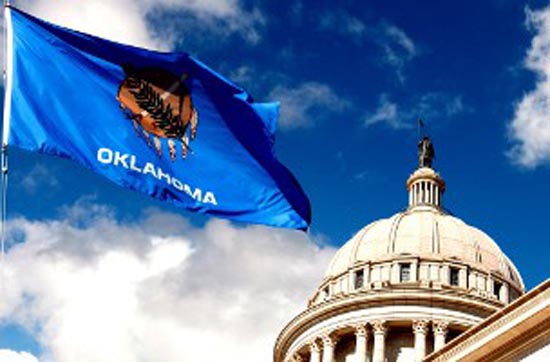
As the Oklahoma Health Care Authority (OHCA) enters the 2026 legislative session demanding nearly $500 million in additional state appropriations, a 35% budget increase that would push its state appropriation from $1.41 billion to $1.91 billion, with maintenance costs alone projected between $354 million and $495 million for FY 2027, the harsh reality has fully set in. What was marketed as a painless way to cover “hundreds of thousands” of low-income adults using “90 percent federal dollars” has become a permanent, ever-growing 10 percent state share that now requires direct general-fund backfills, crowds out core services, and threatens to consume up to 37 percent of the entire state budget within a decade. This is not fiscal prudence. This is the slow-motion fiscal suicide of limited-government Oklahoma.
How a Narrow 2020 Vote Locked In a Constitutional Entitlement
On June 30, 2020, SQ 802 squeaked through with just 50.5 percent of the vote. It added Article XXV-A to the Oklahoma Constitution, mandating expansion of SoonerCare to able-bodied adults ages 18–64 earning up to 138 percent of the federal poverty level (roughly $21,597 for a single person today).
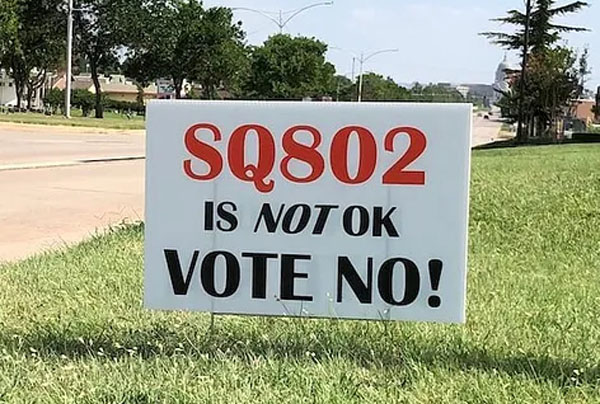
The measure required the OHCA to submit a State Plan Amendment to Washington within 90 days, launch coverage by July 1, 2021, and take “all actions” to maximize federal dollars.
Most importantly, it made the expansion constitutionally required.
Unlike ordinary law, the Legislature cannot repeal it, add meaningful work requirements, impose time limits, or scale it back without sending another question to voters.
Before expansion, Oklahoma was one of the few states wisely resisting the Affordable Care Act’s bait-and-switch. Today, more than 428,573 additional adults have flooded the rolls. Total SoonerCare enrollment now exceeds 1 million, nearly one in four Oklahomans.
Why the Oklahoma Legislature Is “Tied” to SQ802’s Medicaid Expansion — A Textbook Example of Special-Interest Handcuffs on Limited Government
The short answer: The Oklahoma Legislature didn’t voluntarily “tie” itself to anything. State Question 802 was never a bill passed by lawmakers. It was a citizen-initiated constitutional amendment rammed onto the June 2020 ballot by hospitals, medical associations, and out-of-state liberal money. The Republican-controlled Legislature and Governor Kevin Stitt fought it tooth and nail, correctly labeling it an unfunded mandate that would force the state to cover the 10% match on hundreds of thousands of new enrollees with no dedicated revenue source.
But here’s the sneaky genius of the scheme: proponents wrote SQ802 as a constitutional amendment (Article XXV-A) instead of ordinary statute. That single move was deliberate. They knew a future conservative Legislature or governor would try to add work requirements, scale it back, or even repeal it, exactly what happened in other expansion states. By locking Medicaid expansion into the Oklahoma Constitution itself, they made it nearly impossible for elected officials to touch without another statewide vote. Voters passed it by the skin of their teeth (50.5%–49.5%). Suddenly the state was constitutionally required to expand eligibility to 138% of the federal poverty level, “maximize federal participation,” and keep the program running, no matter what. The state share (roughly $200–300 million a year and climbing) comes straight out of the general fund, crowding out roads, schools, public safety, and every other priority Oklahoma families actually voted for when they elected limited-government majorities.
Federal Check Dependency: Why Oklahoma’s Health and Human Services Employees Live on Washington’s Whim
Oklahoma state employees working in Health and Human Services, particularly those at the Oklahoma Health Care Authority (OHCA) that runs SoonerCare (Medicaid) and parts of the Department of Human Services handling eligibility, are directly tied to federal funding for a very simple but dangerous reason: a huge chunk of their salaries and positions are funded through federal matching dollars for program administration.Here’s how it works. Medicaid is a joint program. The federal government matches state spending on actual medical benefits at high rates (around 67-78% blended overall, and a full 90% for the expansion population created by SQ802). More importantly for state workers, administrative costs, eligibility determination, case management, IT systems, oversight, claims processing, are typically matched at 50% by the feds.When voters narrowly passed State Question 802 in 2020 and locked Medicaid expansion into the Oklahoma Constitution (as we detailed earlier), enrollment exploded by hundreds of thousands. That created a massive increase in workload. More enrollees meant more paperwork, more verifications, more bureaucrats needed to “maximize federal participation”, the exact language the constitutional amendment forces on the state. The state then used those ballooning administrative expenses to draw down more federal matching money, money that directly helps pay the salaries, benefits, and pensions of state employees.
In short, SQ802 didn’t just expand coverage. It expanded the government bureaucracy, and a large portion of that bureaucracy is now financed by federal checks to state agencies.
This was always the gamble. Proponents of SQ802, big hospital lobbies, medical associations, and out-of-state liberal money, sold the public on “free federal money” that would supposedly pay for itself through economic growth and hospital revenue. They promised 90% federal funding for the new able-bodied adult population with only a 10% state share from the general fund. They downplayed the risk that Washington politicians could change the rules at any time. They never told voters that tying the program into the Constitution would handcuff future Legislatures and force Oklahoma taxpayers to keep writing bigger checks even if the feds slowed down.
By making it a constitutional amendment instead of ordinary law, special interests made it nearly impossible for elected officials to touch without another statewide vote. As we noted before: “Suddenly the state was constitutionally required to expand eligibility to 138% of the federal poverty level, ‘maximize federal participation,’ and keep the program running, no matter what. The state share (roughly $200–300 million a year and climbing) comes straight out of the general fund, crowding out roads, schools, public safety, and every other priority Oklahoma families actually voted for when they elected limited-government majorities.”
Now, in 2026, that gamble is blowing up in Oklahoma’s face. With the federal government moving toward major Medicaid reforms and spending cuts (accelerated by the Big Beautiful Bill and the new Trump administration’s priorities), the enhanced 90% match is under pressure, administrative funding is less reliable, and the state share is skyrocketing. OHCA has already come begging for hundreds of millions in additional state general fund dollars just to keep the lights on and the payroll met.
When federal money slows or the match rate drops, two things happen: either Oklahoma taxpayers have to backfill with more of their own money (crowding out roads, schools, and public safety), or services and staff get cut. That directly threatens the jobs of the very state employees who were hired or expanded under the SQ802 boom.
This is the classic big-government trap: Create permanent dependency on federal dollars, grow the state bureaucracy on someone else’s dime, then cry poverty when the feds inevitably tighten the purse strings. Oklahomans never signed up for turning our state agencies into appendages of the federal government.
The Sooner State deserves leaders who understand that tying our budget and our employees’ livelihoods to the unreliable promises of Washington bureaucrats was reckless from day one. True limited government means reducing, not increasing, our reliance on federal checks.
Fast-forward to 2026
With federal Medicaid reforms and spending cuts now on the table in Washington, that constitutional handcuff is choking the state budget. Oklahoma taxpayers are now on the hook for any drop in the federal match. The Legislature can’t simply say “we’re opting out” or impose reasonable safeguards without amending the Constitution again, a process that takes time, money, and another trip to the ballot box. This is exactly why limited-government conservatives warned against SQ802 from day one. It wasn’t “the will of the people” in any organic sense; it was special interests using the initiative process to bypass the very representatives Oklahomans keep electing to keep taxes low and government small. The result? A permanent big-government anchor that forces future Legislatures to choose between raising taxes, slashing core services, or watching the budget explode.
Oklahomans who believe in fiscal responsibility now have two choices: live with the mess the 2020 ballot created, or get serious about constitutional reform that restores power to the people’s elected representatives instead of leaving it chained to a narrow 2020 Democratic vote of the people.
The Sooner State deserves lawmakers who can actually govern, not figureheads whose hands are permanently tied by special-interest constitutional traps.
The 90/10 Shell Game: No Dedicated Funding, Just General Fund Pain
Proponents swore the federal government would pick up 90 percent of the tab “in perpetuity.” Yet the amendment created zero new taxes, zero dedicated revenue streams, and zero earmarked funds. Not one penny of tobacco settlement money or hospital fees was constitutionally protected.
The state’s 10 percent match must come straight from the General Revenue Fund, the same limited pot that funds schools, roads, public safety, teacher pay, and tax relief. When the hospital provider fee (SHOPP) falls short, as it did by $45 million in FY 2025, lawmakers are forced to raid general revenue to cover the gap.
The results have been predictable. Overall OHCA spending has exploded by roughly $3.5 billion since 2020, with the state’s share growing faster than promised. Every new enrollee brings a perpetual 10 percent state obligation that grows with enrollment and medical inflation. This is the classic big-government bait-and-switch: promise the world with other people’s money, then stick Oklahoma taxpayers with the ever-increasing bill.
What This Means for the Average Oklahoma Taxpayer
Oklahoma has roughly 1.58 million households. That $500 million additional request alone equates to more than $316 per household, every single year, diverted from family budgets to fund a program that was never supposed to cost state taxpayers beyond the original “10% match” gimmick.
These are not one-time costs. They are permanent, open-ended obligations locked into the Constitution. Some estimates now warn that Medicaid could consume up to 37 percent of the entire state budget, potentially $6 billion in state funds, within the next decade. If Congress ever reduces the enhanced 90 percent federal match, Oklahoma taxpayers would face an immediate additional $453 million annual hit, according to OHCA’s own modeling.
Meanwhile, the General Revenue Fund is being squeezed dry. Lawmakers increasingly face false choices between funding able-bodied adults on SoonerCare or delivering the limited-government priorities Oklahomans actually want, like real tax cuts, better roads, and strong public safety.
Broken Promises and New Bureaucratic Mandates
Expansion supporters promised three things in 2020: it would be “mostly free federal money,” rural hospitals would be saved, and no new taxes would be needed. Instead, hospital fees have been repeatedly hiked and still fall short. Rural hospitals continue struggling. Health outcomes have not dramatically improved compared to non-expansion states. And every shortfall lands squarely on the General Revenue Fund, resulting in higher effective taxes or fewer services for working families already struggling with inflation.
Beyond the money, SQ 802 saddled the state with serious new responsibilities:
* Mandatory annual general-fund appropriations with no escape hatch
* Massive administrative expansion (eligibility, enrollment, federal audits, quality metrics)
* Constitutional handcuffs preventing meaningful reforms like work requirements
* Long-term risk exposure to future federal policy changes
The program originally designed for the truly vulnerable, the elderly, disabled, and children, has been stretched to cover hundreds of thousands of able-bodied adults, creating a permanent underclass of dependency.
A Strike and a Miss, HJR 1067: A Half-Measure That Falls Short
Some lawmakers have recognized the growing crisis. Rep. Ryan Eaves and Sen. Daniels advanced HJR 1067, which would give the Legislature flexibility to scale back expansion only if the federal match rate drops below 90 percent. Governor Stitt has also questioned the program’s long-term sustainability.
While a step in the right direction, HJR 1067 remains a half-measure. It does nothing about the existing 10 percent state obligation already crushing the General Revenue Fund today. Oklahoma families would remain on the hook for hundreds of millions annually unless Washington acts first.
HJR 1067 Does NOT Eliminate the State’s Current 10% Share
The proposed constitutional amendment we at The Sooner Sentinel have championed (the “100% Federal Funding Only” version) is a complete reset of Article XXV-A. It would flip the script on SQ 802 so that Oklahoma never again spends one dime of state taxpayer money on the Medicaid expansion population unless the federal government pays every single penny (100% FMAP).
It does not remove the constitutional mandate to cover the expansion population.
It does not free the General Revenue Fund from the existing $350–$500 million annual burden.
“If the federal financial participation is less than ninety percent (90%) for Medicaid expansion, the Oklahoma Legislature may decide to not cover the additional costs to the state.” Key problems with this language:
- It only kicks in if and when the federal match drops below 90%. As long as it stays at 90% (the current law), the “shall provide” mandate in Subsection A remains fully in force.
- It only lets the Legislature refuse to cover “the additional costs”, not the entire expansion. The core program stays locked in.
- It adds a new Subsection B that actually makes reforms harder: “No greater or additional burdens or restrictions on eligibility or enrollment shall be imposed on persons eligible for medical assistance pursuant to this Article than on any other population…” That language would likely block common-sense conservative reforms like work requirements.
In short: HJR 1067 is a future trigger only. It leaves Oklahoma taxpayers on the hook for the full 10% share today and forever unless Washington decides to cut its own contribution first. Our 100% proposal is the opposite, it gives Oklahoma the power right now.
Why This Matters for Oklahoma Taxpayers
The $500 million+ request for FY 2027 is already here. That’s real money, roughly $316 per Oklahoma household, being pulled from the same General Revenue Fund that should be funding teacher pay raises, road repairs, tax cuts, and public safety. HJR 1067 does nothing to stop that bleeding in 2026, 2027, or any year the federal match stays at 90%.
Our “100% Federal Funding Only” amendment does stop it — cold. It is the clean, conservative solution that puts Oklahoma first, ends the open-ended entitlement, and returns Medicaid to its original purpose: helping the truly vulnerable, not creating a permanent dependent class of able-bodied adults.
The 2026 session is the moment. Lawmakers who truly believe in limited government and low taxation should introduce and pass the stronger 100% language instead of settling for the half-measure in HJR 1067. Anything less keeps the money pit open and the General Revenue Fund bleeding. Oklahomans deserve the real fix.
The Conservative Solution: 100% Federal Funding Only
Oklahoma conservatives must demand a bolder, cleaner fix. The state should amend the constitution to make participation in Medicaid expansion contingent on the federal government covering 100 percent of the costs, with zero state match, zero general revenue, and zero provider taxes.
Here is the stronger language that we should advance:
Proposed Constitutional Amendment – “100% Federal Funding Only”
Article XXV-A, Section 2 is amended to read:
A. In addition to those persons otherwise eligible for medical assistance under Oklahoma’s Medicaid program, the State of Oklahoma shall provide medical assistance under Oklahoma’s Medicaid program to Low Income Adults only if the federal government provides one hundred percent (100%) of the total cost of such medical assistance through federal financial participation.
B. The State of Oklahoma shall have no obligation to expend any state funds, general revenue, provider assessments, or provide any matching funds or percentage share for coverage of Low Income Adults.
C. If the federal financial participation for the expansion population is less than one hundred percent (100%), the Oklahoma Legislature shall have full discretion to decline, modify, limit, reduce, or suspend the expansion program as provided by law, without further constitutional amendment.”
Ballot Title: “This measure amends the Oklahoma Constitution. It provides that the State shall participate in Medicaid expansion only when the federal government pays 100% of the costs with no state match or general-revenue contribution required. If the federal government requires any state percentage or funding, the State may opt out of the expansion entirely. Shall this proposed amendment be approved?”
This proposal does three critical things: It preserves the option for truly free federal money if ever offered, eliminates any state financial obligation otherwise, and restores full legislative authority to protect taxpayers.
The Path Forward: Limited Government, Low Taxes, Real Accountability
Oklahoma was built on self-reliance, personal responsibility, and limited government, not endless dependency on Washington and state entitlements. SQ 802 was a classic case of good intentions paving the road to fiscal disaster. The narrow 2020 vote, the lack of dedicated funding, the constitutional lock-in, and exploding general-fund costs all prove what conservatives said from the beginning: there is no such thing as a free lunch.
The 2026 legislative session is the moment for decisive action. Lawmakers must pass the 100% federal funding only amendment, reject half-measures, return Medicaid to its original purpose of serving the truly needy, and protect the General Revenue Fund for core state responsibilities.
Limited government isn’t just a slogan, it’s the only path to prosperity. Oklahoma families have paid enough. It’s time to fix this money pit before it swallows the entire state budget.
Oklahomans deserve better.
Brief Summary of Proposed Changes to Alleviate This Issue
The primary solution is a new constitutional amendment to Article XXV-A that makes Oklahoma’s participation in Medicaid expansion contingent upon 100% federal funding with zero state match or general revenue requirement. This would eliminate the ongoing 10% state share burden on taxpayers, restore legislative flexibility to modify, limit, or suspend the program without needing another statewide vote, and allow the state to opt out if Washington ever requires any Oklahoma taxpayer contribution. This stronger reform goes beyond the current HJR 1067 by addressing the immediate fiscal pressure rather than waiting for a future federal change. It upholds the principle of limited government while still allowing the state to accept truly “free” federal dollars if Congress ever offers full funding.
Additional supporting steps could include implementing work requirements and proper eligibility verification for current enrollees during the transition.
About the Sooner Sentinel: A team of Conservative Investigative Reporters covers Oklahoma’s convoluted political system on Substack, click here to go to that site where subscriptions are available both free and paid. This story first appeared there and is reprinted on Tulsa Today with permission.