
Understanding Oklahoma’s Expansion of School-Based Services
Most Oklahomans have never been told that our public schools now face a major shift in how student services are defined and delivered. Two very different systems—school-based services and School-Based Health Centers (SBHCs)—are being discussed as if they are the same thing.
THEY ARE NOT.
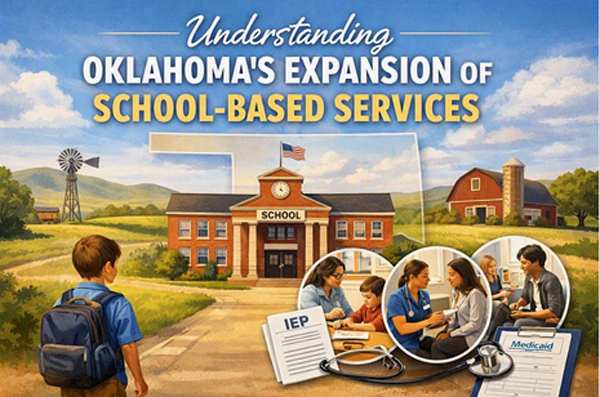
Misunderstanding the difference has serious consequences for families, schools, and children.
There is also an important distinction within Oklahoma’s Medicaid system itself.
Some school-based services are tied directly to an Individualized Education Program (IEP) under the Individuals with Disabilities Education Act (IDEA). Other medically necessary Medicaid services may be provided in a school setting under Oklahoma’s broader Early and Periodic Screening, Diagnostic and Treatment (EPSDT) authority, even when the child does not have an IEP.
Three Different Systems Are Being Discussed
The phrase school-based services can create confusion because it may refer to more than one legal and reimbursement pathway. There are important differences in who provides the service, why it is provided, who pays for it, what rules apply, and what role parents play.
1. IDEA-Related School-Based Services
Some school-based health services are connected to a child’s Individualized Education Program (IEP) under the federal Individuals with Disabilities Education Act (IDEA).
These services are intended to help an eligible student receive an appropriate education. Oklahoma Medicaid rules require documentation supporting the service, including its medical necessity, goals, frequency, duration, and other requirements.
These are not general healthcare services available to every student simply because the student attends public school.
2. Medicaid Services Provided in a School Setting
A second category is different.
Oklahoma Medicaid rules recognize certain non-IEP medical services that can be provided in a school setting under the state’s broader Medicaid/EPSDT authority.
EPSDT is a comprehensive Medicaid child-health program for eligible individuals under age 21. A child does not necessarily need an IEP for a medically necessary Medicaid service to be provided at school, provided the applicable eligibility, coverage, medical-necessity, and documentation requirements are met.
This distinction matters:
Not every medically necessary service provided at school is an IDEA service, and not every Medicaid-reimbursable school service requires an IEP.
3. School-Based Health Centers
A School-Based Health Center is different again.
An SBHC is a healthcare operation associated with a school or school community. Depending on the program, it may provide primary care, behavioral health, preventive care, diagnostic services, and other healthcare.
An SBHC should not automatically be described as an expanded IEP service. It represents a different model of delivering healthcare through a school-connected setting.
The question is not whether children need healthcare.
Of course they do.
The important questions are:
- What healthcare is being provided?
- Under what authority?
- Who is providing it?
- Who is paying for it?
- What documentation is required?
- Who gives consent?
- Who controls the medical records?
- Who is accountable for clinical decisions?
- What role does the school play?
These questions become increasingly important as Oklahoma expands the ability to provide and reimburse healthcare services through school settings.
A School Setting Does Not Make Healthcare Educational
An IEP-related service has an educational connection because it is part of a student’s specially designed educational program.
A medically necessary Medicaid/EPSDT service is a healthcare benefit for an eligible child.
The fact that the service occurs during the school day or on school property does not, by itself, change its legal or clinical character. The same principle applies to SBHCs. The location does not determine the nature of the service.
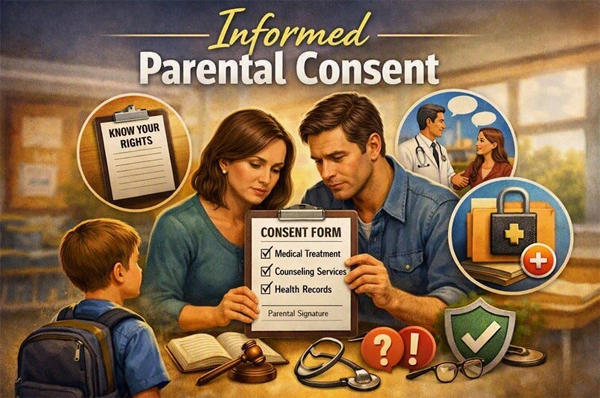
What About Parental Consent?
Oklahoma Medicaid rules recognize parental notification and written consent requirements in connection with accessing public benefits or insurance for IEP-related school-based services. But parents also need enough information to understand what healthcare is being offered through a school-connected program before making a meaningful decision.
Informed consent should include:
- Relevant facts — What is the service? Why is it being offered?
- Risks — What known or reasonably foreseeable risks or adverse outcomes exist?
- Alternatives — What other options are available, including choosing no treatment?
- Understanding — Does the parent have enough information to understand the decision?
- Voluntary choice — Is the decision free from pressure or coercion?
These questions matter because healthcare decisions involve the relationship among the parent, child, school, and healthcare provider.
Schools and Healthcare Providers Have Different Roles
Public schools have an educational mission. Healthcare providers have a clinical mission. Parents have an important role in decisions concerning their children. While these roles can work together for the benefit of children they should not become indistinguishable.
A school nurse providing routine school health support is not necessarily the same thing as a medical clinic operating within a school.
An IEP-related occupational therapy service is not the same thing as primary healthcare.
An EPSDT service provided at school is not automatically an educational service.
And an SBHC is not simply another name for an IEP-related school-based service.

The Bigger Question
The debate should not be reduced to: “Should schools provide healthcare?”
A better question is: What healthcare services should be available through school settings, under what authority, with what safeguards, and with what role for parents, schools, healthcare providers, and Medicaid? As Oklahoma considers expanding healthcare delivery through schools, families deserve clear answers.
- How will parents be notified?
- What constitutes informed consent?
- Who has access to medical records?
- How are services coordinated with a child’s existing healthcare providers?
- Who is accountable for clinical decisions?
- How are Medicaid billing and documentation requirements enforced?
- And how can healthcare delivery occur without unnecessarily interfering with instructional time?
These are reasonable questions—not objections to children receiving healthcare.
Keeping the Categories Clear
There is room in Oklahoma for both education and healthcare. Children need access to appropriate healthcare. But expanding healthcare through public schools makes it especially important to clearly distinguish among education, medicine, Medicaid, and parental authority.
The basic distinctions are simple:
- IDEA-related school-based services are not the same as EPSDT services provided in a school setting.
- EPSDT services provided in a school setting are not automatically IDEA services.
- School-Based Health Centers are not simply another name for IEP-related school-based services.
- Healthcare does not become an educational service merely because it is delivered at school.
- Different services can involve different legal authorities, eligibility requirements, reimbursement rules, documentation, consent requirements, and lines of accountability.
As Oklahoma considers further expansion, these distinctions should become clearer—not less clear. Children can receive appropriate healthcare without erasing the boundary between education and medicine.
Schools Teach. Clinics Treat. Parents Decide.
Keeping these roles clear is not about denying children healthcare. It is about making sure everyone understands:
- Who is doing what.
- Under what authority.
- With whose consent.
- And with what accountability.

About the author: Deborah Campbell may be reached by email at nooklahomak12sbhc@gmail.com and her work is first published on Substack here. You may subscribe on Substack for free to receive new posts.