
Why Limited Government and Market-Driven Innovation Beat the Old Regulatory Capture Model
The Regulatory Trap Holding Oklahoma Back
Oklahomans are tired of watching their electric bills rise while being told the only remedy is more government-approved spending on the same century-old system. The Oklahoma Corporation Commission continues to entertain rate cases from utilities that pass the costs of aging infrastructure and new demand straight through to captive ratepayers. At the same time, technological progress in solar, batteries, and small modular nuclear reactors offers a fundamentally different path, one that rewards results rather than spending. The contrast is stark, and it reveals why limited government, low taxation, and the removal of regulatory control over daily economic decisions consistently outperform bureaucratic gatekeeping.

Elon Musk’s Vision for Energy Abundance
Elon Musk has consistently argued that one of humanity’s most important goals should be making electricity abundant, reliable, and inexpensive. Affordable energy underpins nearly every aspect of modern life, from manufacturing and transportation to agriculture, housing, computing, and artificial intelligence. In Musk’s view, lowering the cost of electricity reduces the cost of almost everything else, creating greater prosperity and expanding economic opportunity on a global scale.
Musk believes the fastest path to energy abundance is through free markets, where competition and innovation drive down costs without political gatekeepers deciding which technologies are allowed to succeed. While he strongly supports renewable energy, particularly solar power paired with battery storage, he has also expressed support for keeping safe nuclear power plants in operation and recognizes nuclear energy as a valuable source of clean, dependable electricity. His approach is technology-agnostic: whichever solutions, whether solar, batteries, advanced nuclear, or other sources, can safely deliver the largest quantities of affordable electricity at scale should be allowed to compete freely. Limited government and open markets, rather than subsidies, mandates, or regulatory favoritism, are what best enable rapid progress and lower prices for everyone.
Cronyism Threatens the Free-Market Future of AI
Large language models and generative AI represent one of the most powerful engines of innovation and productivity in the modern economy. As the St. Louis Fed has documented, AI already drove nearly 40 percent of U.S. GDP growth in the first three quarters of 2025. In a true free-market system, these technologies would continue to develop through open competition, rapid iteration, and voluntary exchange, delivering lower costs, new tools, and genuine progress without political gatekeepers deciding who gets access or how the technology may be used. Limited government allows this process to unfold naturally, rewarding those who create value and letting consumers and businesses decide what succeeds.
Yet the Mises Wire article by Henry Lever shows how cronyism and regulatory capture are already undermining that promise. Frontier labs such as Anthropic have deliberately portrayed advanced AI as an existential danger while positioning themselves as the only “responsible” players deserving government favor. Through fear-based marketing, calls for licensing, testing mandates, and even pauses on development, these companies invite the state to tilt the playing field in their direction, exactly the sort of public-private partnership that Rothbard and Chodorov warned would ultimately destroy free enterprise itself. The result is already visible: export bans, tightened access rules, and the federal government gaining unprecedented control over which Americans and which companies may use the latest models. Once the state holds that power, it does not shrink; it expands, turning a dynamic market into another arena of political favoritism and restricted innovation.
The lesson for limited-government advocates is clear. AI’s continued advance depends on keeping the federal government out of the business of picking winners, setting technical standards, or deciding who may build and use these tools. When companies lobby for regulation to hobble competitors, they do not secure safety, they hand the state a weapon that will eventually be turned against the very innovators who sought its help. Preserving a genuinely free market in AI is not merely an economic preference; it is essential to keeping the technology from becoming another lever of centralized control.
The Century-Old Centralized Control Utility Model
Contrast that with the Oklahoma Corporation Commission. In recent months the OCC has been reviewing rate hikes for Public Service Company of Oklahoma and other utilities, including temporary increases and proposals that would add meaningful additional costs to residential bills. These requests are justified by the very utility companies that the OCC is suppose to regulate. This need to upgrade aging infrastructure and serve growing demand, much of it driven by data centers and additional commercial loads.
The problem is not the demand. The problem is the model. Oklahoma’s regulated utilities continue to operate under a 100-year-old framework built around centralized generation, an aging long-distance transmission system, and cost-of-service rate recovery. In this system, large power plants produce electricity far from where it is consumed, and the costs of building, maintaining, and upgrading that centralized infrastructure are passed directly onto captive ratepayers. Because the OCC protects the monopoly status of these utilities (look up the term “Regulatory Capture”), there is little competitive pressure to innovate, reduce costs, or adopt more efficient technologies. When expenses rise, whether from fuel volatility, weather-related upgrades, or new transmission lines, ratepayers have no choice but to pay, and pay.
A decentralized model offers a fundamentally different approach. By allowing power to be generated closer to where it is used, through behind-the-meter generation, co-located small modular reactors, or customer-owned systems, the need for massive centralized plants and extensive transmission infrastructure is reduced. This model creates real competition, gives consumers and businesses more control over their energy supply, and prevents the automatic socialization of costs that defines the current system.
The “free market” approach rewards results: build better technology at scale and prices fall. The OCC’s centralized model rewards spending: expand the monopoly’s rate base and rates rise. One path leads to abundance and lower costs. The other leads to higher bills and slower economic growth. The Oklahoma Legislature should stop pretending these two models are compatible.
Progress at the NRC on Small Modular Reactors
The second encouraging development comes from the federal level. The U.S. Nuclear Regulatory Commission has begun treating small modular reactors, especially light-water designs, with the seriousness they deserve instead of subjecting them to the same endless process used for giant legacy plants.
NuScale Power’s VOYGR design became the first small modular reactor to receive full NRC design certification. The original 50-megawatt module was approved years ago; the uprated 77-megawatt version received Standard Design Approval in May 2025 after a streamlined 22-month review. Other light-water SMRs from Holtec and others are advancing through pre-application stages with noticeably less friction than in previous decades.
Why Light-Water SMRs Change the Future Equation
This is not deregulation for its own sake. It is the recognition that smaller, factory-built reactors with passive safety features do not require the same regulatory burden as 1,000-megawatt plants designed in the 1970s. The NRC has also moved forward with new licensing frameworks aimed at faster, more predictable reviews for advanced reactors.
Technically, these reactors differ from the large plants of the 1970s in important ways. Light-water SMRs use ordinary water as both coolant and moderator, the same fundamental technology as most existing U.S. reactors, but packaged in factory-fabricated modules. Passive safety features rely on natural circulation, gravity, and thermal properties rather than active pumps or external power. In many designs, the reactor vessel sits inside a steel containment submerged in a water pool that serves as the ultimate heat sink. If power is lost, decay heat removal occurs without operator action or external systems for extended periods.
What Are Gen III+ Reactors?

Oklahoma has approximately 1.604 million households, representing the number of occupied homes across the state. When including vacant units, the total number of housing units rises to roughly 1.65 to 1.70 million. With an average household size of about 2.55 people, these figures indicate that Oklahoma’s residential sector consists of roughly 1.6 million homes that require electricity service. A single 77 MW reactor could power roughly 3–4% of Oklahoma’s total households, while a full multi-module SMR plant could support a much larger share.
A single 77 MW Gen III+ small modular reactor, such as NuScale’s VOYGR design, could realistically provide power for a small to mid-sized town of roughly 40,000 to 55,000 people. This estimate is based on average U.S. electricity consumption, where one module operating at a high capacity factor would generate enough energy to support approximately 50,000 to 65,000 homes. In practice, the actual population served would likely be on the lower end of that range once peak demand, transmission losses, and mixed residential-commercial-industrial loads are taken into account. The reactor would be particularly well-suited for powering a data center campus or a combination of a smaller town and local industry, as these loads tend to run at high, steady utilization rates. For larger cities, multiple modules could be deployed together to scale capacity as needed.
Gen III+ reactors represent the latest evolutionary step in nuclear reactor design. They build on the proven light-water reactor technology used in most of the world’s operating nuclear plants today, but with significant improvements in safety, efficiency, and construction methods.
- Light-water reactors use ordinary (light) water as both the coolant and the neutron moderator.
- Gen III+ designs incorporate passive safety systems — meaning they can shut down and cool themselves using natural forces (gravity, convection, and natural circulation) without needing pumps, external power, or immediate operator action.
These reactors are often designed as Small Modular Reactors (SMRs), which are much smaller than traditional large reactors and can be factory-built in modules and shipped to the site for assembly.
Gen III+ designs focus heavily on passive safety and modularity, making them safer and potentially more affordable than previous generations.
A Market-Driven Path for Today’s Natural Gas
Small-Scale Distribution for Oklahoma Homes
Oklahoma families deserve reliable, affordable natural gas without the heavy hand of federal mandates or the crony deals that favor massive pipeline projects. One practical option is to encourage smaller, limited-distribution natural gas systems designed to serve clusters of 100,000 to 500,000 homes. These localized networks, think regional pipelines feeding targeted neighborhoods or mid-sized cities rather than continent-spanning mega-lines, can be built faster, at lower cost per household, and with far less disruption to private property. By keeping scale modest, Oklahoma can sidestep the eminent domain battles and endless federal permitting that inflate costs and concentrate power in the hands of a few large operators.
This approach aligns with limited government by shifting decisions back to the state level and allowing private companies, both established utilities and smaller competitors, to compete on merit. States like Oklahoma could streamline permitting for these smaller systems, reduce regulatory barriers that currently favor big players, and let market demand determine where gas lines are extended. The result would be more resilient supply for heating and power generation, lower long-term rates for families, and genuine innovation instead of one-size-fits-all projects that invite political favoritism. Just as cronyism in other sectors distorts outcomes, energy policy should reject centralized control in favor of decentralized, voluntary solutions that keep costs down and choices open for Oklahomans.
Limited Government in Energy Policy
The common thread is clear. When government acts as a gatekeeper that protects incumbents and slow-walks new technology, energy stays expensive. When government focuses on clear safety rules, property rights, and getting out of the way of private innovation, costs fall and supply rises.
The Oklahoma Legislature should direct the OCC to prioritize competition and customer choice rather than approving every automatic rate recovery for legacy assets. State permitting for SMR proposals should be streamlined and should not duplicate or contradict the NRC’s work. Policies that force ratepayers to subsidize any single technology while blocking others should be rejected. Let the free market consumers and businesses decide whether they want rooftop solar plus storage, new nuclear, natural gas, or combinations of the above.
The goal is not more government programs. The goal is cheaper, more reliable electricity produced by whoever can best deliver it at the lowest cost.
The Global Cost of Expensive Energy
Denying cheap electricity to emerging nations is immoral, and modular nuclear offers one practical path forward, including right here in Oklahoma.
Energy is the foundation of human progress. Without reliable, affordable electricity, countries cannot industrialize, run hospitals, power schools after dark, refrigerate food and medicine, or build modern economies. Billions of people in developing nations still live in energy poverty. Blocking or artificially inflating the cost of abundant power keeps them trapped in poverty, shortens lives, and wastes human potential.
This is not a neutral policy choice. When wealthy nations or international institutions slow the deployment of cheap energy technologies, through over-regulation, opposition to nuclear, or insistence on intermittent sources without adequate backup, they effectively deny developing countries the tools that lifted the West out of poverty. Cheap, scalable energy has always been the great equalizer.
AI’s Electricity Hunger and the Behind-the-Meter Solution
We continue to point out that electricity generation and delivery as the primary constraint on technological progress, especially artificial intelligence (AI). AI training and inference at scale require enormous amounts of reliable, 24/7 power. Traditional grids are struggling to keep up, and intermittent renewables alone cannot provide the firm base-load needed without extremely costly and massive overbuilding.
Our broader argument is that making electricity dramatically cheaper and more abundant is the highest-leverage way to accelerate human prosperity. For AI data centers specifically, we have highlighted the coming power crunch and explored solutions that bypass slow grid interconnection and permitting. One practical approach gaining traction across the industry is co-locating power generation directly with the compute load, often called “behind-the-meter” generation.
Modular nuclear reactors fit this model exceptionally well. They can be factory-built, sited right next to data centers, deliver steady carbon-free power around the clock, and scale in modules rather than requiring a single massive plant. Several major tech companies are already pursuing nuclear deals for exactly this reason: reliable power without waiting years for new transmission lines or fighting rate cases that socialize costs onto existing customers.
But “We The People” Object, and We Should
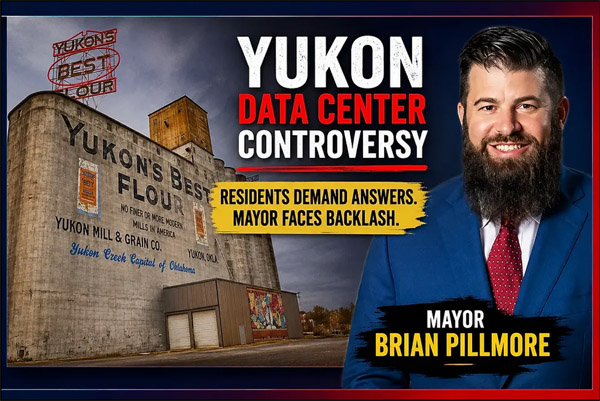
One of the most common objections to large data centers in Oklahoma is their heavy water consumption. Much of this water use comes from the traditional evaporative cooling systems, which reject massive amounts of heat by evaporating water into the atmosphere. While effective, these wasteful uses of our ground water systems have sparked significant local backlash. For example, in Yukon, a proposed data center has triggered intense public opposition, leading to the resignation of the Vice Mayor and calls for the Mayor to step down.
Rather than directly addressing residents’ concerns about water usage and long-term costs, the Mayor has instead focused on how the city could increase it’s revenues by an estimated $16 million to $24 million annually. These are dollars the city “could, maybe, might, possibly” stand to gain in additional revenue through higher sales tax collections, property tax revenue, and other payments, revenue that would most likely come at the direct expense of higher water and electric consumption, along with potential increases in electric rates for local Yukon utility and taxpayers.
A more practical and technical solution already exists which is being adopted by leading data center operators. Shifting from evaporative cooling to direct-to-chip liquid cooling, paired with large dry coolers, can reduce water consumption by 80 to 95 percent. In this approach, liquid is circulated directly to cold plates on GPUs and CPUs*, carrying heat away in a closed loop before it is rejected through air-cooled radiators rather than evaporative towers.
- CPU stands for Central Processing Unit. This is the main processor in a computer that handles general computing tasks. GPU stands for Graphics Processing Unit. This is a specialized processor originally designed for rendering graphics, but now widely used in AI data centers because it is extremely efficient at performing the massive parallel calculations required for artificial intelligence and machine learning.
Pollution from Large-Scale Evaporative Cooling
Evaporative cooling in power plants, data centers, and industrial facilities mainly causes water-related pollution.
Key Types of Pollution:
- Blowdown discharge (most significant): Evaporation concentrates minerals/salts and treatment chemicals (biocides like chlorine/bromine, corrosion/scale inhibitors, heavy metals). The purged “blowdown” water, when discharged to rivers, lakes, or sewers, causes:
- Increased salinity and TDS harming aquatic life
- Toxicity from biocides
- Eutrophication (algal blooms) from nutrients
- Overloading of wastewater plants . . . Hyperscale data centers (millions of gallons/day) and power plants.
- Drift deposition: Airborne water droplets carry concentrated salts and chemicals, depositing on nearby soil, vegetation, and structures.
- Soil salinization (especially with seawater systems), plant damage, corrosion, and minor particulate matter (PM). More pronounced near coastal facilities.
- Thermal pollution: Warmer discharged water reduces oxygen levels and stresses aquatic ecosystems.
These issues are well-managed with modern equipment (e.g., drift eliminators, treatment systems), but they remain concerns in large operations without proper controls.
Eliminate “Behind the Meter” Tax Breaks
Oklahoma has already taken concrete action that aligns with this approach. In 2025, the legislature passed SB 480, the “behind-the-meter” bill, which allows large industrial users and data centers to build and operate their own on-site generation without forcing utilities to plan for or recover those costs through rates charged to everyone else. Governor Stitt signed it, and lawmakers followed up in 2026 with the Data Center Consumer Ratepayer Protection Act to ensure large loads pay their “fair share” of any grid-related infrastructure while shielding residential and small business customers.
This is limited-government policy in action: it reduces regulatory friction and grid interconnection delays, and it prevents the socialization of costs that the Oklahoma Corporation Commission has historically approved through traditional rate cases. It creates space for private innovation, whether that means natural gas, solar-plus-storage, or future modular nuclear reactors sited directly with the load.
However, true limited government requires one important correction. All state tax breaks and special incentives tied to “behind-the-meter” projects should be eliminated. Tax preferences of this type distort free markets, favor politically connected projects, and create new forms of government control under the guise of encouragement. The core value of behind-the-meter generation lies in removing barriers so that private capital can respond to real demand. Adding tax subsidies reintroduces government picking winners. Oklahoma should keep the structural reform but strip away the tax favors.
When combined with behind-the-meter generation, first using natural gas then future small modular reactors, data centers can achieve both highly reliable power and dramatically lower water usage without placing additional strain on municipal water systems or forcing costs onto municipal ratepayers.
Real Economic Gains from Energy and Technology
The same principle applies globally and locally. Denying or delaying cheap energy, whether through outdated utility monopolies in places like in Oklahoma or through regulatory and political barriers in emerging nations, harms the working people.
USA GDP per capita (GDP divided by population) has roughly doubled in nominal terms over the past 20 years, while real (inflation-adjusted) GDP per capita has risen by about 28%. Real output per person has grown steadily despite population growth of roughly 15%, two major recessions, and aging demographics. This reflects gains in productivity, innovation, and capital investment.
Climate Change, Adaptation, and the Case for Cheap Power
Every summer, like clockwork, the same conversation returns in many countries: heatwaves trigger media hysteria about record temperatures and calls to restrict technologies that make life livable. The standard attack line is that anyone pushing back is a “climate denier.”
For the sake of argument, let’s accept that human activity may contribute somewhat to the changing climate. The more important questions are what to do about it and whether current conditions are historically unprecedented.
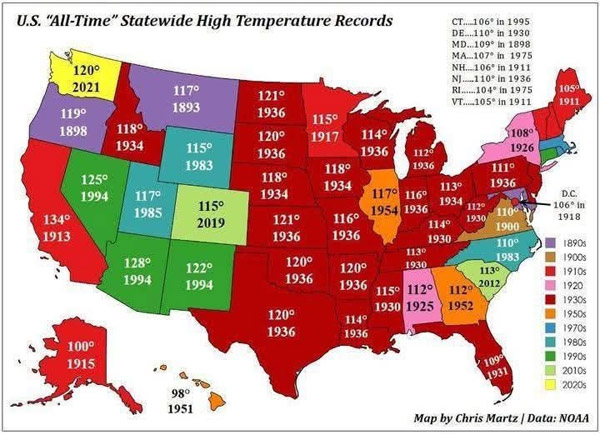
Neither current global temperatures nor the recent rate of change are historically unprecedented on meaningful timescales. Over the past few thousand years, large parts of the Northern Hemisphere experienced long periods under ice sheets or tundra. The last inter-glacial period was much warmer than today. Temperature shifts of several degrees have occurred naturally, and can occur within in decades, not millennia. During the Roman occupation of England and the Scottish Highlands the medieval warm period supported agriculture at latitudes much farther north than today. The Little Ice Age of a few hundred years ago, which lasted from roughly 1300 to 1850, brought regular frost fairs on the frozen Thames River in London.
We face a choice where mainstream media commentary seems incapable of framing it honestly: what to do about something you cannot prevent? The answer is improvise, adapt, and overcome (yes, a saying from my old USMC days). For example, Florida’s population exploded after air conditioning became widespread in the 1950’s because technology made such an inhospitable climate livable. Cognitive performance research shows that extremes of heat without temperature control reduces human output on complex tasks. Adaptation requires prosperity. Prosperity requires affordable energy.
Making energy deliberately more expensive through state and federal regulation along with subsidies for favored technologies reduces the resources available for adaptation. The realistic response is to pursue abundant, low-cost energy through free market competition and innovation so that societies can afford the adaptations that actually improve resilience.
GANN, WEST, & WEST File Oklahoma Supreme Court Challenges Against OCC
Oklahoma Representatives Tom Gann, Kevin West, and Rick West have filed repeated appeals to the Oklahoma Supreme Court challenging Oklahoma Corporation Commission orders that have saddled ratepayers with billions in utility rate increases, post-Winter Storm Uri fuel charges, and securitization bonds. These lawmakers argue that the OCC failed to conduct proper independent audits required by state law, allowed an embattled commissioner with apparent conflicts to participate in key decisions, and denied ordinary customers meaningful participation in rate cases. Their filings seek to protect taxpayers from improperly approved costs that continue to appear on monthly bills.
Instead of backing these efforts to enforce accountability and protect consumers, Attorney General Gentner Drummond’s office has consistently defended the OCC orders in court. The AG has filed briefs opposing the lawmakers’ challenges, argued against strict audit requirements, defended the commissioner’s participation, and even sought to dismiss or pause the appeals. An AG opinion also blocked ethics investigations into the commissioner, shielding the regulatory process from further scrutiny while ratepayers foot the bill for billions in disputed charges.
This approach represents a clear failure by the Attorney General’s office to fulfill its duty to represent Oklahoma ratepayers and taxpayers. Rather than acting as a check on an unaccountable regulatory agency and powerful utilities, the AG has aligned with the bureaucracy, enabling questionable approvals and procedural shortcuts that limited-government principles demand be corrected. The contrast is stark: while Gann, West, and West use their positions to challenge government-enabled overcharges, the AG’s office has chosen to prop up the status quo at the expense of everyday Oklahomans.
These ongoing Supreme Court cases highlight a troubling pattern in which state officials entrusted with protecting the public purse have instead prioritized institutional defense over taxpayer relief. Until the Attorney General’s office shifts its focus from shielding regulators to aggressively pursuing refunds and reforms, Oklahomans will continue paying the price for regulatory failures that limited government was meant to prevent.
Closing Summary
Oklahoma’s electricity challenges stem not from insufficient government spending or planning, but from an outdated regulatory capture model that protects utility monopolies while automatically passing along rising costs onto ratepayers. The Oklahoma Corporation Commission’s continued reliance on “cost-of-service” rate recovery rewards monopolistic capital expenditures rather than efficiency and innovation, keeping power much more expensive than necessary.
A better path exists through limited government and genuine market competition. Dramatically cheaper and more abundant electricity through scaled technology demonstrates what may become possible when artificial barriers are removed. At the federal level, the Nuclear Regulatory Commission’s more realistic treatment of small modular reactors shows that modern designs can be deployed with greater speed and lower cost when regulation matches technological reality rather than clinging to outdated standards.
Oklahoma has already taken a constructive step with its behind-the-meter legislation, which allows large users to generate their own power without forcing costs onto other customers. However, to stay true to limited-government principles, all state tax breaks and subsidies associated with these projects should be eliminated. True competition does not require government favoritism or special treatment.
The stakes are both local and global. Affordable, reliable energy is essential for prosperity, productivity, and human development. Real U.S. GDP per capita has risen nearly 28 percent over the past two decades, reflecting the gains that come from innovation and abundant energy. At the same time, restricting access to cheap power in developing nations is morally indefensible, as it denies billions the tools needed to escape the extremes of poverty.
On climate, adaptation through greater prosperity and technological capability is more effective than policies that deliberately raise energy costs. Societies that can afford resilient infrastructure and modern technologies are far better positioned to handle changing conditions than those made poorer by restrictive energy policies.
Oklahoma should now move forward decisively. The OCC needs to be reformed to prioritize competition, streamlining permitting for safe advanced technologies, removing tax favors from behind-the-meter rules, and allowing all forms of energy to compete on merit to deliver lower costs, greater reliability, and stronger economic growth. The choice is clear: continue defending a system that keeps power expensive, or remove the barriers that prevent better solutions from reaching Oklahoma’s tax and ratepayers.
The Path Forward for Oklahoma
The Oklahoma Legislature has an opportunity to lead this effort. Reform the OCC to emphasize competition over cost recovery for legacy systems. Streamline Oklahoma’s processes for natural gas and safe SMR deployment. Eliminate all state tax breaks for behind-the-meter generation so the policy remains a genuine reduction in regulatory control rather than another subsidy program. Embrace technological diversity through open competition rather than central planning.
When government gets out of the way of results-oriented solutions, costs fall and abundance rises. Oklahomans deserve the opportunity to choose that path.
Check out some of our previous articles on this topic:
The Captured Commission: How Oklahoma’s Utility Regulators Became Tools of the Monopolies – And How to Break Free
Regulatory Capture at the Oklahoma Corporation Commission (OCC)
A Case For Small Modular Reactors (SMRs) vs. Carbon Capture & Green Energy Tax Credits
The Molten Salt Promise: Why a Next-Generation Nuclear Dream Stays on Paper
About the author: Marven Goodman publishes “The Sooner Sentinel” on Substack and invites readers to subscribe for free at this link which is where this story first appeared today. Goodman is a former Logan County Commissioner, and retired Army Lieutenant Colonel with a passion for digital electronics and computer science. His career began in 1973 as a U.S. Marine Corps avionics bench technician, troubleshooting circuits and exploring binary logic. He earned a Bachelor of Science in Education from the University of Central Oklahoma in 1993, blending military training with computer science studies.
Goodman served as Chief Information Officer on the Oklahoma Adjutant General’s staff and retired from the military in May 2000. First elected as Logan County Commissioner in June 2014, he served through January 2023, bringing his technical and leadership expertise to writing, governance, and public service.