
The Paradox of Silence: Hissom’s Teachers, Including Current Candidate for Oklahoma Superintendent Dr. Robert Franklin, Escaped Accountability
When federal investigators exposed the depravity of the Hissom Memorial Center in Sand Springs, Oklahoma, the public faced an unsettling truth.
In 1987, Hissom Memoral Center was legally condemned by U.S. District Judge James O. Ellison as a “human-development emergency.” the institution was found to have subjected vulnerable children with disabilities to relentless physical abuse, gross medical neglect and widespread chemical sedation of vulnerable children with disabilities.
Yet, an intriguing professional paradox arose from the landmark litigation. Despite the facility’s closure due to inhumane conditions, the teachers who worked there neither faced any judicial consequences nor experienced career repercussions. Instead, Hissom’s teachers cleanly transitioned into local public-school systems. Among them was Dr. Robert Franklin, who taught special education at Hissom for five years, from 1981 to 1986, before embarking on a respected, decades-long career in public school leadership. The key question is how the judicial system and the Oklahoma State Department of Education permitted these educators to keep their licenses and certifications and advance in their educational careers.

The Archival Record of Silence
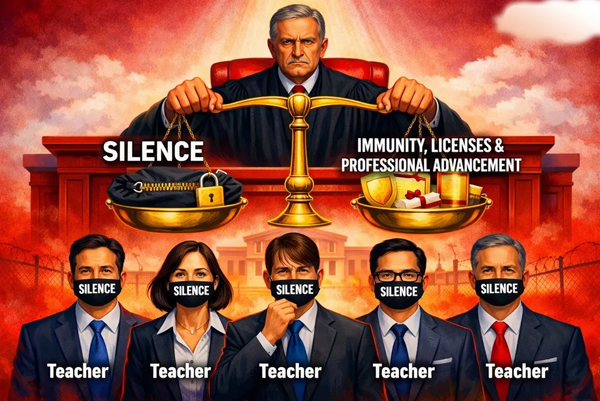
The historical reality preserved in the archival records of the 1985–1987 Homeward Bound, Inc. v. Hissom Memorial Center litigation reveals a significant discrepancy. Despite the severe regression and untreated injuries later documented by the court, the files show no evidence of formal whistleblowing, incident reports, or public exposure of these dark realities by Hissom’s internal teaching staff.
A Failure to Report
Instead, the burden of uncovering the truth fell entirely on parent advocates and investigative journalists. For years, the teachers and other licensed professionals interacting with these children on a daily basis remained silent, resulting in no intervention from the state or legal system.
Insulated by the Institutional Blueprint
To understand why Judge Ellison did not penalize the teachers for their failure to report, one must look at how the court legally separated classroom instruction from institutional management.
The litigation revealed that Hissom functioned as two separate environments. The catastrophic neglect and containment occurred almost exclusively within the residential area, under the direct supervision of institutional aides and medical staff. Because teachers operated strictly within the daytime classrooms, the court’s structural focus legally insulated them from the atrocities occurring on the residential side.
The Absence of Legal Mechanisms
From a legal standpoint, the Homeward Bound lawsuit was a structural civil rights action against the state, not a criminal prosecution of individual employees. Because no classroom teachers were individually named or charged with direct abuse, there was never a legal mechanism triggered to review or revoke their state teaching certificates.
Prioritizing Relocation Over Punishment
Judge Ellison’s historic 1987 Court Plan took a pragmatic approach that favored the teachers’ continued employment. The court recognized that the state’s massive failure was rooted in the institutional model itself—an environment that erased any progress children made during the school day the moment they returned to understaffed wards.
Rather than punishing or investigating the educators for their silence, the final judicial order explicitly prioritized retraining these licensed professionals and moving them into public schools and community homes. The state desperately needed existing, qualified special education personnel to build its new, integrated education system.
A Lasting Lesson in Systemic Immunity
The aftermath of the Hissom case stands as a powerful study in how massive, bureaucratic institutions insulate individuals from accountability.
Teachers like Dr. Franklin and his peers were able to leverage their state licenses to build prominent careers because the federal court chose to lay the blame entirely at the feet of top state leadership.
While the history books will always note that the internal teaching staff did not blow the whistle on Hissom’s dark realities, the legal resolution of the case chose to look forward—utilizing those same silent educators to staff the future of modern special education in Oklahoma.

About the author: Deborah Campbell may be reached by email at nooklahomak12sbhc@gmail.com and her work is first published on Substack here. You may subscribe for free to receive new posts.