
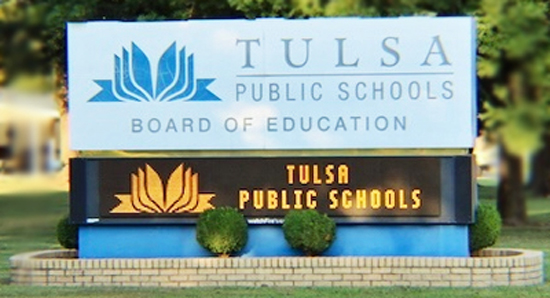
Analysis: Seventeen Tulsa Public Schools. That’s how many schools the Tulsa Public Schools Board voted to close Monday night. Nearly one-quarter of the district’s schools. One out of every four. That’s not a minor administrative adjustment. That’s an institutional earthquake.
I spoke at Monday night’s Board meeting and asked a question that every Tulsa taxpayer, parent, and homeowner ought to be asking: How did this district get into such a colossal mess?

You don’t wake up one morning and discover that seventeen schools have become unnecessary. You arrive at that point after years of enrollment decline, academic failure, financial mismanagement, and missed opportunities to correct course. So where was the leadership? Where were the warnings? Where were the corrective actions? Where was the accountability?

Where Did All the Children Go?
Over roughly fifteen years, TPS has lost approximately 20 percent of its enrollment. Meanwhile, neighboring Bixby Public Schools increased enrollment by approximately 75 percent. Union Public Schools, which shares many of Tulsa’s urban and suburban characteristics, maintained roughly stable enrollment. Oklahoma’s statewide school-age population has also increased rather than declined.
These comparisons don’t establish why TPS lost students. Families move. Housing patterns change. Parents choose different schools. But they raise an obvious question. Are Tulsa schools struggling because families are leaving, or are families leaving because Tulsa schools are struggling?
And does anybody in TPS leadership actually know the answer?
If the district doesn’t understand why families have been leaving, how can it be confident that closing seventeen schools will solve the problem?
The Financial Fig Leaf
We’re told that TPS faces a $12 million budget shortfall. Twelve million dollars sounds enormous. But against approximately $750 million in annual expenditures, that’s just 1.6 percent. One point six percent.
Are we seriously suggesting that a financial problem representing 1.6 percent of expenditures explains the need to close nearly a quarter of Tulsa’s schools?
Perhaps some closures are justified by declining enrollment and excess building capacity. That’s a legitimate argument. But the $12 million shortfall looks suspiciously like a financial fig leaf concealing a much larger institutional problem.
According to Oklahoma’s official 2024–25 School Report Card, only 16 percent of Tulsa Public Schools students tested achieved proficiency or better in English Language Arts. Eighty-four percent did not. That’s not a minor academic problem. That’s an institutional crisis.”
Then there’s financial management. State audits have identified serious failures in financial controls and purchasing procedures. A former senior administrator went to federal prison for fraud. More recent criminal charges involving alleged misconduct with bond funds have raised additional questions about oversight.
And in April, Tulsa voters approved a $609 million bond package. Five months later, the district announced plans to close seventeen schools. What did district officials know about potential closures before that election? What were voters told? And how will these closures affect the investments voters approved? These are reasonable questions. Tulsa deserves answers.

Are We Creating an Enrollment Death Spiral?
There’s another possibility that ought to concern every homeowner in Tulsa. Neighborhood schools help attract families, sustain relationships, and contribute to the stability of communities. Now consider what could happen.
Families lose confidence in TPS. Enrollment declines. TPS closes neighborhood schools. Those neighborhoods become less attractive to young families. More families leave. Enrollment declines again.
Are we solving the problem—or accelerating it? I don’t claim that this cycle has been established. But it is a serious possibility that deserves investigation before additional neighborhoods lose their schools.
And what happens to the seventeen buildings? Will they be sold, repurposed, or left vacant? What will maintaining them cost? What happens to the surrounding neighborhoods? Closing a school doesn’t necessarily eliminate the costs of owning its building—or the consequences for its community.
Where Was the State of Oklahoma?
The responsibility for this situation doesn’t stop at the TPS Board. Oklahoma has a State Department of Education, a State Board of Education, accreditation requirements, performance reports, improvement programs, and an elaborate collection of educational regulations. We have plenty of mechanisms for identifying problems.
What we have not demonstrated is an effective system for ensuring that persistent institutional failure produces meaningful corrective action. For years, Tulsa’s declining enrollment and poor academic outcomes were visible. Yet the district reached a point where closing seventeen schools became its chosen response. Both TPS and the State of Oklahoma owe the public an explanation of how that happened.

And What About the Children?
Perhaps the most important question is what happens to the thousands of children affected by these closures. Some may benefit from better facilities, stronger programs, and additional opportunities.
Others may lose trusted teachers, established support systems, and the stability of a neighborhood school. The children most vulnerable to disruption may be those already struggling academically. TPS should identify those students, establish specific plans to protect their education during the transition, and track their academic progress for at least the next two or three years. And report the results publicly. Not merely whether the buses ran on time or the buildings were emptied successfully.
Tell us whether the children are actually learning more.
A school can close. A building can be sold. A budget can be balanced. But a child gets only one fourth grade. Only one seventh grade. Only one opportunity to receive the education needed at that moment in life. The Board has made its decision. Now it must demonstrate that the decision will benefit the children it exists to educate.
If the best TPS can produce is a smaller, cheaper version of the same troubled institution, it hasn’t solved Tulsa’s educational problem. It has merely reduced its square footage.
About the author: Ken Malloy is a retired energy policy lawyer and former federal regulatory strategist who has spent the last several years working to improve K–12 education governance in Oklahoma. He writes on civic accountability, institutional reform, and the responsibilities of self-government. He can be reached at ken@caem.org.