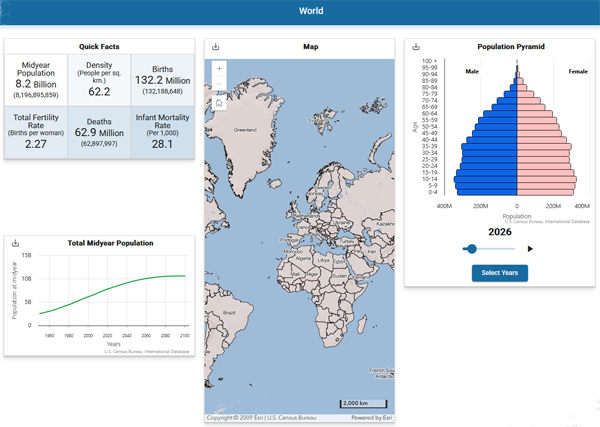
The U.S. Census Bureau released last week new population estimates, projections, and other demographic data up to the year 2100 for 25 countries and areas in the International Database (IDB).
New data and analyses were used to refine population estimates and projections for:
- Four U.S. island territories — American Samoa, Guam, the Northern Mariana Islands, and the U.S. Virgin Islands
- 21 countries — Armenia, Benin, Cyprus, Democratic Republic of the Congo, Ghana, Indonesia, Iraq, Japan, Libya, Mali, Mozambique, Nepal, North Macedonia, South Sudan, Syria, Thailand, Turkey, Uganda, United States, Venezuela, and Vietnam
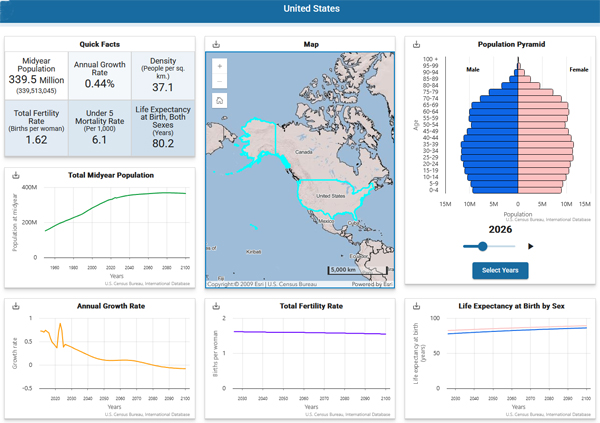
The release also includes data for 16,638 subnational areas similar to U.S. states, counties and townships around the world, along with enhanced mapping features.
The current update incorporates new data from censuses, surveys, and administrative records, along with updated analyses based on that data.
Highlights
This is the first IDB release since 2017 to include updated estimates and projections of four U.S. island territories. These areas are undergoing long-term population decline driven by falling fertility and persistent out‑migration:
- By 2100, American Samoa is projected to lose an estimated 61% of its 2026 population, the U.S. Virgin Islands 41%, Guam 38%, and the Northern Mariana Islands 17%.
- Fertility dropped across all territories, with the total fertility rate in American Samoa falling from 4.0 in 2000 to 2.1 in 2026, and in the Northern Mariana Islands from 3.3 to 2.0 in just a decade.
- Migration patterns further accelerate decline. In 2026, net migration rates ranged from -4.8 per 1,000 in Guam to -25.1 in American Samoa. Although out‑migration is projected to gradually lessen and reach 0 by 2100, current trends point toward significant demographic contraction over the coming decades.
For some of the 20 additional countries, we incorporated new data on crisis‑related mortality and shifts in HIV/AIDS prevalence:
- Turkey’s 2023 earthquake, with an estimated 53,000 deaths, raised national deaths by nearly 7% from the previous year.
- In Libya, catastrophic flooding resulted in over 13,000 deaths, pushing 2023 deaths up 22% and reducing life expectancy from 73.4 to 71.2 years.
- Falling HIV prevalence in Benin, the Democratic Republic of the Congo, and Mali, dropping below 1% between 2020 and 2024, prompted the removal of the HIV/AIDS mortality component from our projections.
Populations are constantly evolving. In some places, these shifts happen gradually, while in others, especially those that have experienced major crises such as conflict, natural disasters, disease outbreaks, or food shortages, change can be abrupt. Most populations fall somewhere in between. They may show slow, steady movement when viewed as a whole, even while certain subgroups undergo more rapid or uneven change. And broad population totals can sometimes hide important shifts in fertility, mortality and migration.
The IDB consists of estimates and projections of demographic indicators, including population size and growth (by sex and single year of age up to 100-plus) and components of change (mortality, fertility and net international migration) for more than 220 countries and areas. The Census Bureau periodically updates the IDB as new data become available.
IDB estimates and projections can be found on the International Database Overview webpage.