
Speaking to the Republican Women’s Club of South Tulsa Monday morning, Joel Hollingsworth, owner of Smoke River Ranch in Strang, Oklahoma outlined his mission to create economically viable ranching models for the younger generation.
“I moved to Oklahoma to follow the call of God to be a part of a movement that’s happening not many people know about yet. Now that I’m here, I have met, and so has my wife Erin, so many people who have moved to Oklahoma to be a part of what I call a Christian forward movement for soil restoration and health restoration being born here,” Hollingsworth said. “We’ve got about five hundred head of cattle and Smoke River Ranch is basically my test bed for figuring out how we make ranching economically viable again.
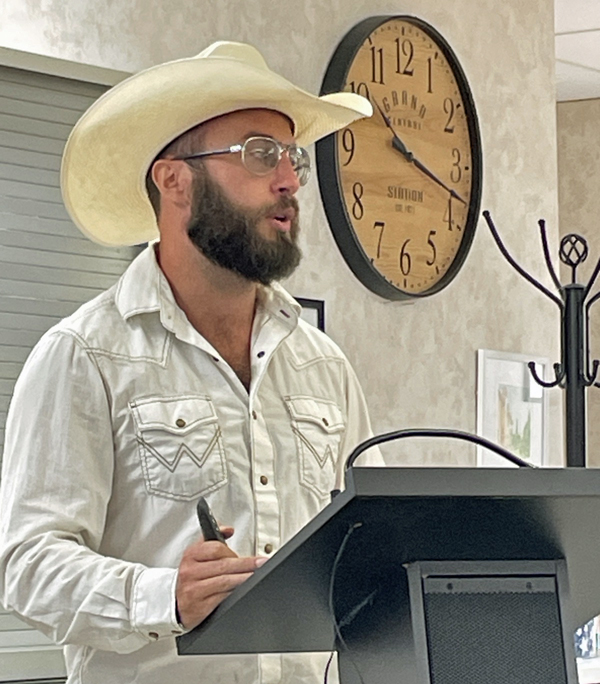
Hollingsworth traces the decline of American agriculture from the stewardship of Native Americans to the ecological devastation caused by the destruction of keystone species like bison and beavers. He connects this degradation to historical events such as the Great Depression, the post-WWII industrialization of agriculture, and the 1970s departure from the gold standard, which introduced distorted economic signals.
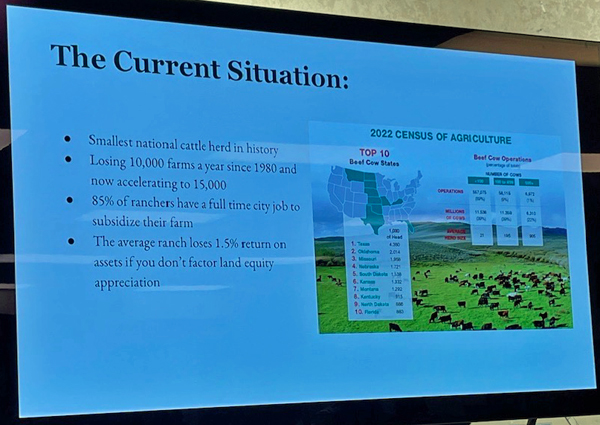
Hollingsworth asserts that these factors, combined with fiat money, have monetized land, making it unaffordable for productive farming and creating a financialized, extractive economy. This has led to a shrinking national cattle herd, an exodus of farms, and a “brain drain” from rural America.
The system is dominated by large corporate and foreign-owned entities operating with impunity, while small, innovative operations are crushed by regulatory overreach.
Historical Roots of the Agricultural Crisis
Hollingsworth detailed how early settlers saw North America as a “natural Garden,” failing to recognize the intentional land management practices of Native Americans, who managed animals, controlled burns, often migrated their usage, and cultivated “food forests.”
European Settlers sought economic opportunity and personal freedom from the “overly bureaucratic tyranny” and restrictive land access of feudal England.
Hollingsworth said, “You had all the rules in the feudalism systems with crop tenancy and farm shares and all that. But it devolved from being collaborative and useful, where the farmers and the landlords worked together to maximize value, to where you didn’t have permission to do anything. When the settlers first landed in America, they thought this was just easy. Like, how in the world is there so much food everywhere? What they didn’t realize is that the Native Americans had intentionally approached it, where they were stewarding the land in a form of agriculture that the Europeans didn’t recognize.”
Problems began, Hollingsworth said with the destruction of keystone species. First went the beavers over-trapped for the European fur trade. The loss of these “little water engineers” and their dams made the landscape drier. Then the government incentivized the intentional genocide of bison as a political move to destroy the Native American way of life and ready the land for settlers. In the name of civilization, this policy annihilated the “keystone soil builders of the Great Plains.”
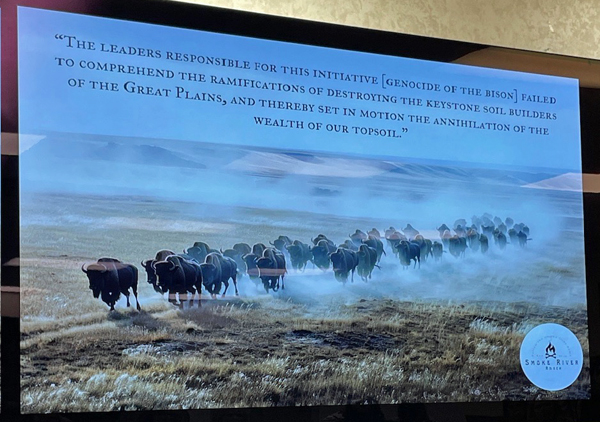
Economic and Political Factors in Agriculture’s Decline
The application of European tillage practices to the Great Plains backfired, leading to massive top-soil loss and the Dust Bowl. This marked the beginning of significant government intervention in agriculture.
Hollingsworth said, “If settlers had a year with very little rain, and what they would do in Europe when they didn’t have a lot of moisture for the crops is till and turn the soil over to turn the moisture back to the surface, and then it would rain again fairly soon, and the crops would survive. They did that. In the Great Plains and especially Oklahoma, as Woody Guthrie sang about, the dirt just blew away.”
Hollingsworth cited David Montgomery’s Dirt: The Erosion of Civilizations, and he emphasized that societies collapse when they extract from their soil rather than steward it. Soil is the “bank of future productivity.” And then, of course, government help began significant intervention in agriculture. Post-WWII production infrastructure was repurposed for agriculture. Nitrogen for bombs became chemical fertilizer, allowing “bad stewardship” to be masked by chemical inputs, driven by Earl Butz’s “get big or get out” philosophy.
The U.S. leaving the gold standard in the 1970s Hollingsworth identified as a root problem, distorting economic signals. This created the “Cantillon Effect,” where those closest to the “money printer” (government, large corporations) benefit most, while wage earners and savers face inflation. This financialization disadvantages smaller, younger innovators.
Weak, inflationary currency turns land into a store of value, driving prices so high that its productive use is no longer economical. Hedge funds and foreign entities buy up land, making it impossible for a farm’s production to pay for the land itself (a 100+ year payback period today vs. 4-7 years in the 1960s-70s).
The theory that a reserve currency nation will see its productive industries collapse is playing out in the U.S. as it became a financialized service economy. Fortunately, President Donald J. Trump is working to reshore manufacturing to save the middle class. To mask declining purchasing power, however, US policy has prioritized artificially cheap food, leading to a reliance on processed foods and a system where only 10-15 cents of every food dollar returns to rural America.
The Current State of the US Ranching Industry
Hollingsworth noted that the US has its smallest national cattle herd in history, with the rate of farm loss accelerating to 15,000 per year. Roughly 85% of ranchers require an off-farm job to subsidize their operation, as the only “profit” comes from land price inflation, not agricultural production.
The food system is characterized by extraction from corporate cartels and foreign entities. JBS (Brazil) is the largest US meat processor, and Smithfield (China) is the largest pork producer.
Imported beef benefits from a 30% margin advantage due to currency differences and faces little inspection, while domestic producers face intense scrutiny. Contamination (antibiotics) and mislabeling (including horse meat) are serious issues.
Regenerative Agriculture and Community-Based Solutions
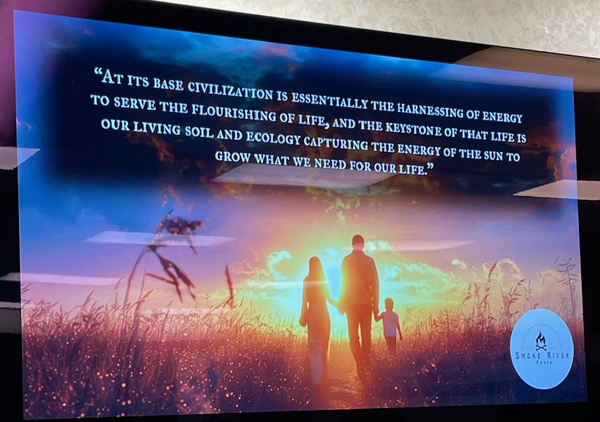
At Smoke River Ranch, Hollingsworth employs “mob grazing,” where 500 cattle are moved six times a day on small plots. This method improves forage use, allows land to rest, captures solar energy, rebuilds soil biology, and restores economic viability. His ranch supports three times the typical number of cattle for the area.
To achieve economies of scale, Hollingsworth advocates for community collaboration. His “herd share” model involves about 40 families owning the breeding stock while he manages the herd. The farm and families share the calf crop, providing food security and asset ownership.
Regulatory Overreach and “Anarchic Tyranny”
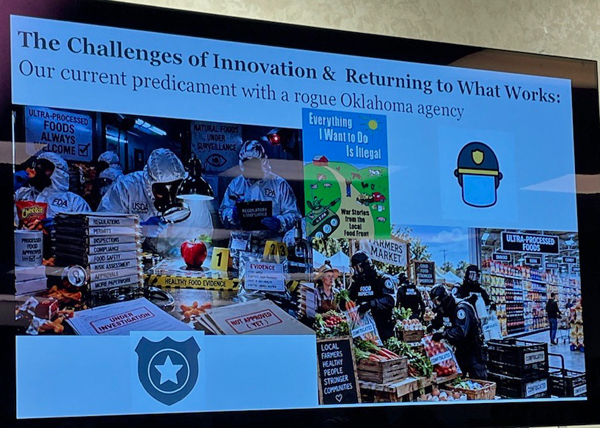
After a social media video about the Smoke River Ranch went viral, the Oklahoma Department of Securities (ODS) subpoenaed Hollingsworth, alleging the farm’s herd-share model (based on centuries of bailment law) should be regulated like a Wall Street security.
The investigation is being conducted under administrative law, where constitutional rights (like the 1st, 4th, and 5th Amendments) do not fully apply. The ODS conducted a “fishing expedition” without any complaints or alleged victims and harassed community members. If charged, the case is heard by a judge who works for the investigating agency, again, with no right to a jury.
Hollingsworth defines this as a system of selective law enforcement where large corporations with lobbyists operate with impunity while small innovators are crushed by government interference. Former Oklahoma Attorney General John O’Connor is now suing the same department for a similar five-year harassment campaign against a private client.
“Control the food, the energy, and the money. Those who control the money and the media can manipulate the whole economy because they have the power we can’t compete against,” Hollingsworth said. “An economist, Saifedean Ammous, said it this way: that ‘when a money is a weak money, everything else has to become money because people run to protect their value.’ And so, like [historic] Weimar Germany, everybody and their shoeshine boy became a day trader. We see that today. Everybody’s always trying to scramble and protect themselves.
“If you think about gold, gold is super useful for electronics and industrial purposes, but it doesn’t get used for it very much because gold is valuable as a store of value mechanism. Those monetary premiums trump its useful nature, and so it is kept in a vault versus used for any sort of production.
“The exact same thing is happening to land. Land is being bought up by hedge funds, by foreign nations, by family offices and high net worth people, and the cost of land has gone so high. Productive land can’t pay for itself anymore. So, back in the ‘60s, ‘70s, our grandparents’ era of farming, you could buy land and pay for a farm in four to seven years of production,” Hollingsworth continued.
“A young person trying to farm today, at current interest rates and land prices, need years, a hundred years, if ever, maybe, probably not. And the reason is because of leaving the gold standard. The way that the dysfunction of fiat money printing has wrecked productive industry. Economy descends from vibrant production to imperialistic extraction under inflation.
“The thing with inflation is that when that money gets cheaper, those who are printing the currency are robbing from your bank accounts quietly, even though you still hold the same number of dollars under your mattress,” Hollingsworth added.
Under the Biden Administration inflation ran over 7.5 percent. In a little over a year, the Trump Administration has inflation down to 3.4 percent and it is expected to fall further.
Hollingsworth closed declaring that achieving change requires voter engagement and social media pressure on representatives. He is seeking an Attorney General opinion for legal clarity on farm freedoms and hopes a future AG will be more collaborative. There is a Washington Post story on Smoke River Ranch and Regenerative Agriculture set to publish soon.
Readers may learn more about Smoke River Ranch at this link and email farm@smokeriverranch.com with any questions. Joel Hollingsworth, owner of Smoke River Ranch in Strang, Oklahoma continued the conversation on YouTube.com/@straightupdave here:
About the author: David Arnett’s beginning in print journalism was not planned in 1985 but covered by the Columbia Journalism Review in 1987. After 11 years in print, he established TulsaToday online in 1996 and Straight Up on Substack in 2022 providing email subscriptions. In April 2026, he began the YouTube Channel, Straight Up Dave. Arnett is identified nationally as a “Veteran Oklahoma Political Journalist” and locally as an “Equal Opportunity Aggravator.”