
America and the world noted how Communist China abused control over critical mineral supplies after their military (with US funding) created and spread COVID. Japan depends on other nations for raw materials and felt this harm deeply. With common sense leadership, Japan moved to address the issue and has now successfully recovered rare earth rich mud from the ocean floor at depths of around 6,000 meters near Minamitorishima Island, marking a world-first technological milestone according to Inspenet (professionals in the energy industry) and Reuters.
Today, the Governments of the United States of America and Japan on the occasion of a visit to Japan by a U.S. interagency delegation focused on seabed minerals development released the following joint statement.
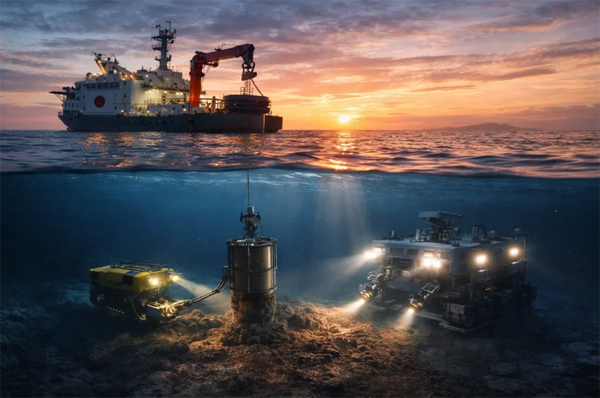
The recovered material is believed to contain critical elements such as neodymium, dysprosium, gadolinium and terbium—key inputs for defense systems, electric mobility and advanced electronics. Japan’s success supports broader efforts to diversify supply chains amid global concerns over concentration of refining and processing capacity.
The Joint Statement Begins:
The Governments of the United States and Japan reaffirm that economic security cooperation is an indispensable part of the U.S.-Japan Alliance and that secure, resilient, and diversified critical mineral supply chains are essential to the prosperity and national security of both countries. The two governments recognize the potential for responsible seabed mineral resource development to diversify critical mineral supplies, create new commercial opportunities, and support the two countries’ industrial bases.
This cooperation builds on the shared objectives set out in the United States-Japan Framework for Securing the Supply of Critical Minerals and Rare Earths through Mining and Processing, signed by President Trump and Prime Minister Takaichi in October 2025, and is being advanced through U.S.-Japan bilateral initiatives, including the Memorandum of Cooperation (MoC) between the U.S. Department of Commerce and the Japanese Ministry of Economy, Trade, and Industry signed in March 2026. The two governments welcomed progress under the MoC, including the second meeting of the U.S.-Japan Working Group on November 11 and 12 in Toyama, Japan, which included discussions on Japan’s rare-earth mud project near Minamitorishima Island and its polymetallic nodules project, as well as expanded engagement among government officials, industry stakeholders, researchers, and technical experts.
Looking ahead, the Governments of the United States and Japan plan to advance the following priorities:
- Deepen engagement with U.S. and Japanese industry stakeholders and foster trusted commercial partnerships across the full seabed mineral supply chain;
- Secure processing capacity among trusted partners to reduce supply chain vulnerabilities;
- Safeguard sensitive technologies and proprietary information;
- Exchange information and best practices on advanced technologies and methodologies related to deep-sea exploration, seabed mapping and resource characterization, environmental assessment, mitigation and monitoring, technological innovation, and resource development;
- Explore opportunities to advance scientific understanding such as coordinating access to, and use of, vessels, autonomous underwater vehicles, and other relevant assets in support of joint research, technology demonstrations, and respective U.S. and Japanese seabed exploration campaigns;
- Facilitate regulatory exchanges related to best practices, including for mitigation and monitoring, technological advancements, environmental assessments, data management, and adaptive management, consistent with national laws and policies;
- Promote clear, streamlined, and predictable regulatory approaches that facilitate private investment in the seabed minerals sector;
- Promote complementarity between domestic and international regulatory regimes to support commercial viability and long-term certainty for industry; and
- Seek additional partnerships to advance responsible seabed mineral resource development.
The two governments reaffirm their commitment to whole-of-government coordination and practical cooperation that mobilizes their complementary scientific, technological, industrial, diplomatic, and financial strengths. They intend to support commercial opportunities, encourage private-sector investment, and foster trusted partnerships across mineral supply chains to accelerate responsible seabed mineral resource development, strengthen critical mineral security, and advance the shared economic security of the United States and Japan.