
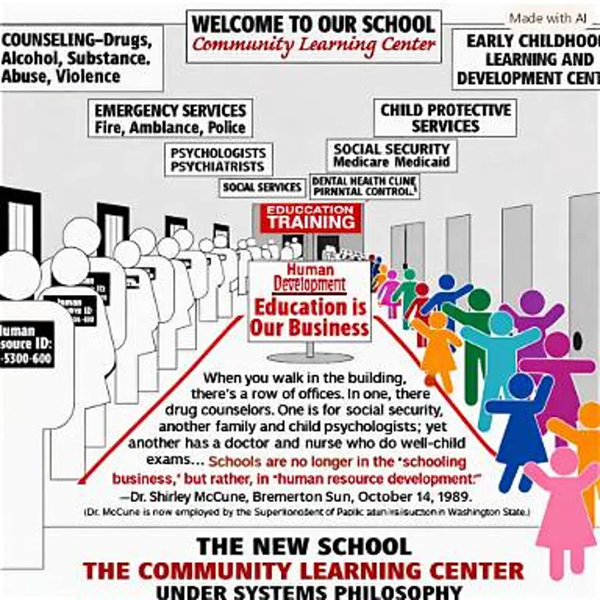
Analysis: School-based healthcare is no longer limited to services traditionally connected to special education. Oklahoma already permits certain health-related and rehabilitative services through schools, while federal policy is encouraging states to expand school-based Medicaid and behavioral-health services. At the same time, school-based health centers can introduce a broader healthcare-delivery operation into a public school.
The question is not whether children need healthcare. They do. The question is whether public schools should become a larger part of healthcare delivery systems, and if so, where the boundaries should be drawn.

This paper argues that Oklahoma should clearly distinguish educational services from primarily medical services, protect meaningful parental authority and informed consent, preserve instructional time, maintain strong Medicaid and IEP oversight, and establish statewide rules before further expansion.
I. What Are School-Based Health Services?
“School-based health services” is a broad term. Services may be provided on a school campus, through telehealth, at an off-campus location, or through another arrangement connected to a school. Depending on the program and applicable law, services may include physical therapy, occupational therapy, speech and language services, psychological or behavioral-health services, diagnostic services, nursing, and other medically necessary services.
Oklahoma’s Medicaid rules address school-based health-related and rehabilitative services provided by qualified school providers to eligible students under applicable requirements. They also address certain non-IEP medical services provided in a school setting. These are not all the same legal program.
The important point for parents is simple: a healthcare service does not become an educational service simply because it is provided at school, and Medicaid reimbursement does not by itself make a service an IDEA-related service.
II. School-Based Services and School-Based Health Centers Are Not the Same
Two different types of expansion are often discussed as though they were identical.
· Expanding school-based health services means increasing the types, number, or eligibility of health-related services connected to schools.
· Expanding school-based health centers (SBHCs) means establishing or expanding an organized healthcare operation in or associated with a school.
An SBHC may provide primary care, preventive care, behavioral healthcare, diagnostic services, reproductive -health services, or other medical services, depending on the program. It may involve a healthcare organization, federally qualified health center, behavioral-health provider, or other outside entities.
An SBHC therefore raises questions that go beyond adding an educational support service: Who owns and operates the center? Who employs and supervises the clinicians? Who controls medical records? Who bills Medicaid? Who determines medical necessity? What information is shared with the school and parents? What services require affirmative parental consent? Who handles complaints and clinical oversight?
These questions should be answered before a clinic is established or expanded.
III. Where Education Ends and Healthcare Begins
Public schools have an educational mission. IDEA provides special education and related services to eligible students with disabilities so they can benefit from special education and receive a free and appropriate public education (FAPE).
A health-related service can be included in an IEP when it is also educationally necessary. In other words, the service must be required for the child to benefit from special education or receive FAPE and otherwise meet IDEA requirements.
Medical necessity and educational necessity are therefore not interchangeable. A child may have a legitimate medical need without that medical service becoming an IDEA-related school obligation.
The basic distinction is:
Medical need → educational impact → educationally necessary related service
The IEP team must make an individualized determination. Medicaid reimbursement should not determine whether a service belongs in an IEP, and a service should not become an educational service merely because it can be delivered at school.
This distinction protects both students and schools. Students who need services to access education should receive the services required by law. At the same time, public schools should not automatically become general healthcare providers simply because a school is a convenient location.
IV. Parents, Notification, and Informed Consent
Parental involvement is a central safeguard in school-based healthcare. Oklahoma and federal rules already contain consent and notification requirements in particular circumstances, including certain use of public benefits or insurance and certain telehealth services.
The broader policy question is whether those requirements always give parents enough information and enough time to make a meaningful decision.
What Informed Consent Should Mean
A meaningful informed-consent process should provide parents with enough information to understand what they are being asked to authorize. At a minimum, parents should know:
· What service, treatment, testing, program, or activity is being proposed;
· Why it is being offered and what its scope is;
· Who will provide it and under whose authority;
· The relevant risks and potential consequences;
· The available alternatives, including declining participation when legally permitted;
· What information will be collected and who may have access to it; and
· How consent may be declined or withdrawn when the law permits.
Notification is not the same as informed consent. Notification tells a parent that something is being offered. Informed consent gives the parent enough relevant information to make a knowledgeable, voluntary decision.
Opt-Out Versus Affirmative Consent
Under an opt-out system, participation may be the default unless a parent takes action to decline. Under an affirmative-consent system, the parent must actively authorize participation before the service occurs.
These systems are not equivalent. For healthcare, diagnostic testing, sensitive health information, or other services with significant consequences, Oklahoma should carefully consider whether affirmative parental consent is the more meaningful safeguard.
Statewide minimum standards could also address how notice is delivered, how much time parents receive, what information must be provided, and how consent is documented and verified. Leaving these matters primarily to local policies can produce significant differences from one district to another.
V. Mental and Behavioral Health
Mental-health treatment is healthcare. Schools can appropriately identify students who may be struggling and help connect families with resources, but screening, referral, counseling, diagnosis, and treatment are different activities.
Parents should be able to understand who is conducting a screening or providing treatment, what information is collected, who receives it, when consent is required, who pays for the service, and who controls the resulting medical record.
The more extensive a school-based program becomes, the more important it is to keep educational responsibilities and healthcare responsibilities clearly defined.
VI. Medicaid, IEPs, and Accountability
Oklahoma’s Medicaid program permits reimbursement for certain school-based services when applicable requirements are met. Those requirements are separate from IDEA’s rules governing IEPs.
The distinction matters because an IEP is an educational document. Medicaid eligibility or reimbursement does not independently establish IDEA eligibility, create an IEP, or transform a medical service into an educational service.
Oklahoma’s history also shows why strong oversight matters. Federal Office of Inspector General audits of the state’s school-based Medicaid program identified significant questioned or unallowable expenditures. A 2002 audit identified approximately $1.9 million in projected federal financial participation associated with expenditures that were not in compliance with federal guidelines and CMS policy. A 2003 audit identified additional unallowable federal costs and problems involving referrals, state-share calculations, billing arrangements, and provider qualifications.
These are historical findings. They do not establish that current Oklahoma schools or healthcare providers are engaging in the same conduct. They do demonstrate why expansion should be accompanied by documentation, financial controls, auditing, and independent oversight.
· Claims should correspond to services actually provided.
· Services should be billed under the correct legal authority.
· IEP services should have a documented educational connection.
· Medical necessity should not be substituted for IDEA’s educational-necessity standard.
· Reimbursement opportunities should not drive educational determinations.
VII. Protecting the Academic Mission
Schools already carry substantial responsibilities for instruction, special education, student safety, transportation, discipline, testing, attendance, and compliance with state and federal education laws.
Expanding medical and behavioral-health responsibilities can require additional personnel, space, funding, administration, documentation, and oversight. It can also affect instructional time when students leave class for services. Lost instructional time cannot simply be recovered.
This does not mean every school-based therapy is inappropriate. For some students with disabilities, an educationally necessary related service may be essential to accessing and benefiting from classroom instruction.
The question is whether primarily medical services should automatically be delivered during instructional hours simply because the school is a convenient location.
VIII. What Oklahoma Should Ask Before Further Expansion
Before expanding school-based healthcare or school-based health centers, Oklahoma should require clear answers to several basic questions.
· What services are educationally necessary, and which are primarily medical?
· Which services are IDEA-related, and which operate outside the IEP?
· What services require affirmative parental consent, and which require only notification?
· What information must parents receive, and how much time must they have to review it?
· Who owns and controls medical records, and what information is shared with the school?
· Who employs, supervises, and disciplines healthcare providers?
· Who determines medical necessity and who provides clinical oversight?
· Who bills Medicaid, who audits the claims, and what happens when problems are found?
· How much instructional time is lost to services?
· What public funding is being received, where is it being spent, and what outcomes are being measured?

IX. My Recommendation: The Stay in Your Lane Act
Based on the concerns identified in this paper, I recommend adoption of the “Stay in Your Lane Act,” a draft bill for 2027 currently seeking legislative sponsors.
The purpose of the Act is straightforward: establish statewide boundaries between Oklahoma’s K–12 public schools and the healthcare industry while protecting lawful educational services, parental authority, and accountability.
The Act is not intended to prevent students from receiving medical services that are legally required through an IEP or Section 504 Plan. Instead, it distinguishes educationally necessary services from general healthcare and establishes clear expectations for schools, healthcare providers, and state agencies.
The Act would:
· Keep public schools focused on their primary educational mission while preserving legally required IEP and 504 services.
· Limit healthcare-provider access to school campuses except for medical emergencies or services expressly required by an IEP or 504 Plan.
· Prevent a healthcare service from becoming an educational service merely because it is delivered at school or reimbursed through Medicaid.
· Establish boundaries around school participation in healthcare recruitment, enrollment, telehealth, referrals, counseling, and healthcare-related contracts.
· Protect parental authority in decisions concerning children’s healthcare.
· Require meaningful accountability for contracts, funding, billing, records, and compliance.
· Provide enforcement mechanisms rather than leaving compliance entirely to individual districts.
· Promote statewide consistency so parents do not face substantially different expectations simply because their children attend different public schools.
The underlying principle is simple: schools should educate, healthcare providers should provide healthcare, and parents should retain their lawful authority over their children’s healthcare decisions.
X. Conclusion
The debate over school-based healthcare should not be reduced to the question, “Do children need healthcare?” Of course they do.
The real questions are: Who should provide it? Where should it be provided? Who makes the decisions? What role does the parent have? Who pays for it? Who is accountable? And what should the primary mission of the public school remain?
Oklahoma already has school-based health services, and federal policy is encouraging further expansion. That makes clear boundaries more important, not less.
A health-related service that is educationally necessary may appropriately be delivered through a school. But a medically necessary service does not automatically become an educational service merely because it can be delivered at school or reimbursed through Medicaid.
Likewise, establishing a healthcare center in a public school is not simply an extension of the school’s educational function. It creates a healthcare relationship that requires clear standards for parental authority, medical records, provider accountability, clinical oversight, billing, and informed consent.
Children deserve access to appropriate healthcare. Parents deserve transparency and meaningful involvement in decisions concerning their children. Teachers deserve clarity about their responsibilities. Healthcare providers deserve clearly defined professional boundaries. Taxpayers deserve accountability. And public schools deserve a clearly defined mission.
Before Oklahoma further expands the healthcare role of K–12 public schools—or establishes or expands school-based health centers—the state should first demonstrate that the existing system is transparent, accountable, properly overseen, and consistent with the state’s educational mission and the rights and responsibilities of parents.
The issue, then, is not whether children need healthcare. They do. The issue is whether public schools should become an increasingly significant point of healthcare delivery—and, if so, where the boundaries should be drawn.
Public schools have an important responsibility, but that responsibility is education. Healthcare providers have a different responsibility: providing healthcare. Parents have the primary responsibility and lawful authority to make healthcare decisions for their children, subject to applicable law.
As Oklahoma considers further expansion of school-based health services and school-based health centers, these boundaries should remain clear:
Schools should educate. Healthcare providers should provide healthcare. Parents should retain their lawful authority over their children’s healthcare decisions.
That is what it means to Stay in Your Lane.
About the author: Deborah Campbell may be reached by email at nooklahomak12sbhc@gmail.com and her work is first published on Substack here. You may subscribe on Substack for free to receive new posts.