
Picture a horse that has carried kings, crossed deserts, starred in Hollywood films, and outlasted every empire that ever tried to claim it. Now picture more than a thousand of them, gathered in one place, competing for the title of the best in the nation. That is what happens every autumn in Tulsa, Oklahoma, and on October 22-31 at Expo Square the Arabian Horse Association is throwing the biggest celebration in its history: the sixtieth anniversary of the United States National Championships.

The story begins modestly. In 1958, two classes were judged on the Fourth of July weekend in Estes Park, Colorado, one for stallions and one for mares. Nine years later, in a three-day show in Albuquerque, New Mexico, the National Championships stood on their own for the first time. Nobody in that dusty August of 1967 could have imagined what came next.
Today the event is the largest and most diverse national championship for any breed of horse anywhere on the planet, and since 2008 it has called Expo Square in Tulsa home. This year marks the twenty-fourth time Oklahoma has crowned a National Champion, more than any other state in the history of the show.
Why does one breed draw such devotion? Start with the fact that the Arabian is the oldest horse on Earth.
Long before there were show rings, Bedouin tribes of the Arabian desert bred these horses for one purpose: survival. A horse had to be fast enough to outrun raiders, tough enough to cross hundreds of miles of sand on little water, and, above all, trustworthy enough to sleep beside the family. Prized mares were raised inside the tent alongside children. Thousands of years of that partnership produced a horse with an almost uncanny bond with people, which is why Arabian owners so often describe their horses as members of the family rather than livestock. That gentleness is not a training trick. It is in the blood.
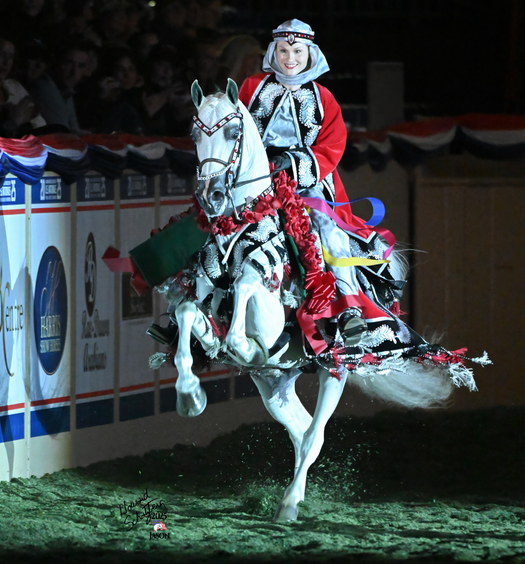
So is the athleticism. No other breed competes in more disciplines. At Tulsa you will see horses in tuxedo-worthy formal driving harness, horses working cattle like their cowboy ancestors, horses in flowing Arabian costume, horses trotting so high they seem to float, and horses dressed for the trail. Remarkably, many of the early champions did all of it in the same week.
Khemosabi, one of the breed’s great heroes, still holds a record no horse has matched in fifty years: champion in both beauty and performance in the United States and Canada. A horse named Bask arrived from Poland in the early 1960s, won a national title in halter one year and under saddle the next, and went on to become the most influential sire the breed has ever known. His descendants number in the hundreds of thousands, and nearly every Arabian in the ring at Tulsa carries his name somewhere in its family tree.

The Arabian also has a habit of capturing the public imagination. The breed took root in America after the 1893 World’s Fair in Chicago, when a herd brought from the Ottoman Empire could not afford the trip home and was sold at auction to Americans who had fallen in love with them. In 1980 an Arabian stallion named Cass Ole starred in “The Black Stallion” and a generation of children grew up dreaming of a black horse on a beach. In Colorado, an Arabian named Thunder galloped across the field at Denver Broncos games for years. The horse has always had a way of finding its audience.
The sixtieth anniversary in Tulsa is a celebration of all of it: the legends of the past, the champions of today, the amateur owners and small breeders who have always been the backbone of the breed, and a horse whose beauty, courage, and generous heart have captivated humanity for thousands of years. Come and see why. Once you have looked an Arabian in the eye, you will understand what the Bedouin knew all along.
About the author: Taryl O’Shea is Chief Executive Officer of the Arabian Horse Association, which serves Arabian horse owners, breeders, and enthusiasts and promotes the Arabian and Half-Arabian horse through competition, education, and community.