
Private Fiber Lines Revealed in Public Right-of-ways
Are high speed commercial Fiber Optic Lines being installed illegally in Oklahoma to connect multiple data centers? Are public utility rights-of-way being used for private commercial installations without the knowledge or permitting approval of local and state officials? Are Oklahomans being bamboozled by the monied elite for billions of dollars over decades with no compensation provided to local property owners? Could this be happening within clusters of data centers nationwide?
Phyllis Fallen heard a construction crew approaching her property on 660 Road one mile south of the Mayes County-Wagoner County line in Oklahoma. When she stepped outside and asked what they were doing, the crew said they were laying a fiber optic line. No compensation was offered, and no documentation was initially produced.
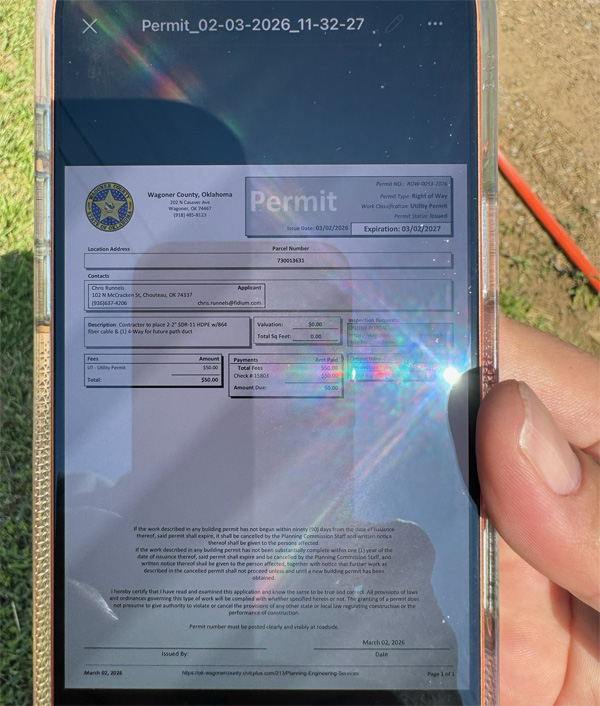
Fallen insisted on seeing a permit. The workers claimed to have a “blanket county-wide permit,” but said it was with their supervisor. After a wait of 30–60 minutes, the supervisor arrived and retrieved a permit on his phone. With permission, she photographed, enlarged, and read it, then informed him he was on the wrong road. He reiterated the “blanket-county wide” permit coverage several times, but she asked to see that specific documentation. She told this writer, “He appeared exasperated and said it would take time; she said she would wait.”
Shortly thereafter, the supervisor admitted they were on the wrong road. He described the need to revise the permit and proposed stopping work and moving to 270 Road, returning once the revision was obtained. He asserted they would never rip through her yard and would bore beneath the road and lawn. Phyllis countered that the workers had said they would rip through the yard and potentially sever existing lines especially the family home’s water line.
Fallen’s suspicions grew as the supervisor’s explanations shifted between “boring” and visible “plowing” practices. She noted the risk to existing services and noted the crew lacked visible survey markers, creating uncertainty about whether they were within public easement or on private property. The supervisor later returned, presented another permit which when examined revealed the crew was on the wrong side of the road.
Fallen said, “I do not believe the wrong side of the road was a mistake. I believe that was done intentionally which violated their permit. The north side has trees and tree roots and south side is cleared including my yard so it’s much easier to dig.”
The supervisor stated they were revising the permit while continuing work down 270 Road. He added, “I have a family to feed,” and urged her to “stay quiet,” which she refused, citing protection of her property rights.
Phyllis Fallen is a realtor and knows a bit about easements, royalties, and property rights. She is not a woman to be taken lightly.
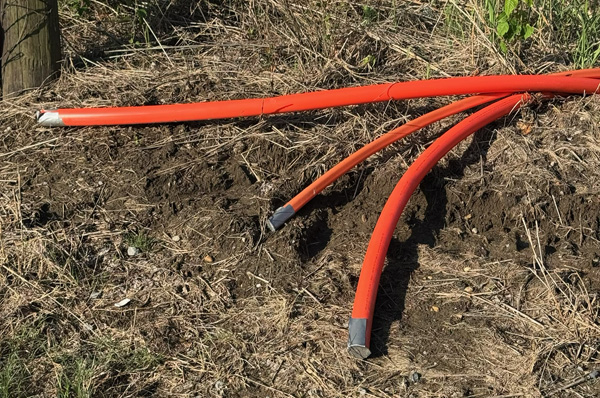
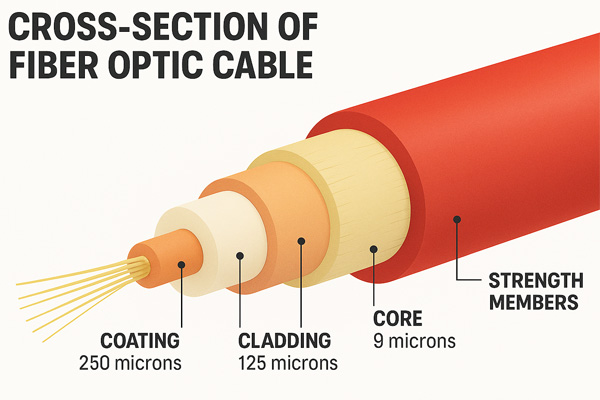
The crew was attempting to install three lines, one public “Four Way” line that would be available for public use and two “two-inch” lines. Fiber optics or optical fiber are thin strands of glass that can be transmitted over, via optical equipment that transforms data signals into light. This thin, flexible glass strand has a similar diameter to that of human hair, around 125 microns (µm) or 0.125 millimeters (mm). A two-inch line is a grouping of individual optical fiber lines and is not used for small business or residential transmission.
On May 26, Fallen presented her questions at the Wagoner County Board of County Commissioners’ meeting. A Fidium Fiber representative spoke first during the agenda item on public utility easements. She directly asked which of the three lines were for public use. The Fidium representative publicly admitted that “two of those lines are private lines.” Immediately, a Consolidated supervisor attempted to clarify that “anybody can hook onto this line if they qualify,” but did not refute the admission of two private lines. He did not detail what determined “if they qualify.”
Additional public input raised tax and registration concerns. In remarks by Chris Leffingwell, it was suggested that private lines might not be registered with the State of Oklahoma and might not be reported to the county assessor for usage taxes. Wagoner County Assessor Sandy Hodges asked the representatives if they were registered with the state; they became quiet and did not answer. Separately, both Phyllis’s husband and neighbor, John Mell, overheard workers say they were under a nondisclosure and could not disclose the line’s ownership, reinforcing suspicions of private ownership and undisclosed intent for the two 2-inch lines.
Both Wagner and Tulsa Counties utilize the planning and development services of the Indian Nations Council of Governments (INCOG). Tulsa County recently approved the Clydesdale Project, a large data center in north Tulsa County. Currently and for the last year, Stan Sallee has served as chair of INCOG. Sallee is also running for reelection as Tulsa County Commissioner (District 1).
The question to all three Tulsa County Commissioners is simple. Did the Clydesdale Project detail to Commissioners prior to approval of the project how data would be received and sent? Commissioner Lonnie Sims (District 2) remembers vague mention of fiber optic. Commissioner Kelly Dunkerley (District 3) said he did not.
Sallee, who as chair of INCOG knew about the project for over a year before it was made public responded by text writing, “It’s my understanding there is existing infrastructure. (Fiber)”
There is no known fiber infrastructure at the Clyedesdale location that could handle high-capacity traffic for a data center. How could elected public officials not know that fact? What is missing? Public Transparency! Independent Review! True Facts!
There were massive protests and hearings before Tulsa County Commissioners approved of the Clydesdale Project, but concerns were focused on the facility and the immediate residential area, not on every private property owner between that project and any other project(s) to which they might want to connect.
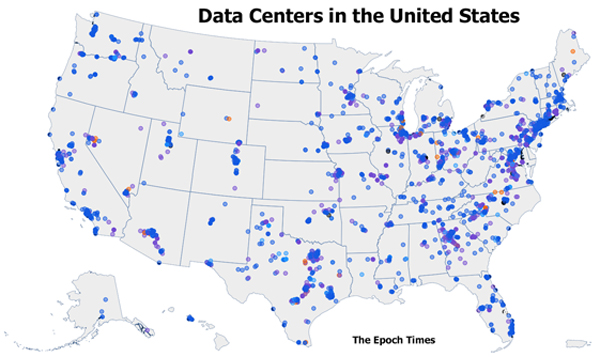
The Epoch Times in a May 15 story reports, “The United States currently has more than 3,100 data centers in operation and more than 1,800 in various stages of development, according to data provided by infrastructure intelligence and mapping platform Data Center Map.
Virginia, Texas, and California lead the nation in the number of data centers, according to the platform. Virginia alone has a combined total of 711 currently operational, under-construction, and planned centers. Texas has a combined total of 544, and California, 333.
These data facilities are typically massive buildings housing information technology infrastructure, data-storage systems, and networking and processing equipment. They also require power subsystems, backup generators, and HVAC and cooling systems to prevent hardware from overheating.
According to a recent Pew Research Center analysis, 87 percent of existing data centers are located in urban regions, while 67 percent of planned data centers are targeted for construction in rural areas.
“These structures tend to be built in clusters: Nine in 10 data centers are within five miles of another one,” the report notes. “As a result, a majority of Americans who live near one data center also live near at least one more.”
The permit description cited by Fallen refers to “two 2 inch SDR-11 HDPE with 864 fiber cable and one four-way for future path duct,” with the four-way duct represented by a lighter orange, square-profile conduit in photographs she referenced.
The visible installation method along county roads involved plowing: a four-foot-deep ripper blade that feeds duct from spools, rapidly trenching and laying conduit but leaving disturbed ground conditions. In contrast, boring is a minimally invasive technique.
At the Wagoner County meeting, Chris Leffingwell, knowledgeable about fiber deployment, added technical clarifications. He stated that splicing and connectivity require vaults every approximately 10,000 feet (nearly two miles), which are expensive due to polishing and precision splicing to maintain signal strength. He suggested the large 2-inch ducts and the limited splicing strategy are not geared for typical residential service drops, which rely on neighborhood pedestals and distribution laterals. He posited that public consumer access to such lines would be unlikely due to security and operational concerns, implying the 2-inch ducts serve private, high-security communications rather than general consumer broadband.
Fallen escalated the matter legally, retaining Barber & Bartz attorney Joe Fears, who advised that two threshold legal questions must be answered before proceeding: whether the public easement is restricted to public use or can lawfully host private lines, and whether county commissioners have authority to allow installation of private communication lines in public easements without property owner permission.
This story will be continued.
Editor’s Note: This story is co-published on Tulsa Today and on Straight Up on Substack which provides free and paid subscriptions with email delivered at the time of publication. Interviews on this topic are also forthcoming on YouTube/@StraightUpDave.
About the author: David Arnett’s beginning in print journalism was not planned in 1985 but covered by Rebecca Martin writing for the Columbia Journalism Review in 1987. After 11 years in print, he established TulsaToday online in 1996 and Straight Up on Substack in 2022 providing email subscriptions. In April 2026, he began the YouTube Channel, Straight Up Dave. Arnett is identified nationally as a “Veteran Oklahoma Political Journalist.”