
When I wrote recently that the Roberts Court appears to be restoring the constitutional boundaries between Congress, the President, and the federal courts, I had no idea that only days later the Supreme Court would decide a case that answered a constitutional question I had personally wrestled with thirty-five years ago.
This week’s decision overruling Humphrey’s Executor is being reported as another dispute over presidential power. I see it differently. I see it as the Supreme Court finally resolving a constitutional argument that took place inside the George H. W. Bush Administration in 1991.

At the time, I was heading the natural gas policy group at the Department of Energy. We were implementing President Bush’s National Energy Strategy, which recommended major additional reforms to the nation’s natural gas transportation system. The policy question was whether those reforms should be implemented through one comprehensive rulemaking or by making gradual changes one case at a time.
The policy issue was important. The constitutional issue behind it was even bigger.
The Constitution establishes only three branches of government: the Legislative Branch, the Executive Branch, and the Judicial Branch.
Independent regulatory agencies, however, occupy an unusual place in our government. They perform executive functions, they conduct proceedings that resemble judicial hearings, and they issue regulations that sometimes resemble legislation. For decades they have occupied a constitutional gray area.
That gray area became the subject of a remarkable internal debate.
Representing the Department of Energy was Assistant Secretary Linda Stuntz. Representing the constitutional position of the White House was Counsel to the President Boyden Gray. Participating in the discussions was Dr. Richard Schmalensee of the Council of Economic Advisers, one of the nation’s leading regulatory economists, with Adam Jaffe serving on his staff. Across the table sat Martin Allday, Chairman of the Federal Energy Regulatory Commission.
Although only a handful of people were directly involved, they were debating an issue that would eventually reach the Supreme Court more than three decades later.
Boyden Gray’s constitutional argument was elegant in its simplicity.
The Constitution creates only three branches of government. The President is vested with the executive power and charged with faithfully executing the laws. If an agency exercises executive authority, then the President must ultimately have the authority to direct that agency’s policy. Otherwise, an unelected body would be exercising executive power independent of the elected Chief Executive.
FERC saw the matter very differently.
It relied on the Supreme Court’s 1935 decision in Humphrey’s Executor, which held that Congress could create independent regulatory commissions insulated from direct presidential control. Under that precedent, the President could recommend. The President could persuade. But the President could not command the Commission to adopt a particular regulatory policy simply because it reflected the Administration’s program.
Both sides had respectable legal arguments because Humphrey’s Executor remained the law.
Fortunately, the constitutional dispute never became a constitutional crisis.
FERC strongly opposed undertaking another major rulemaking. The Commission had already completed several major natural gas rulemakings during the previous six years, each of which had produced years of litigation in the federal courts. The Commissioners preferred to continue refining natural gas regulation through individual cases.
I disagreed.
Having participated in developing Order 436, I believed that continuing on a purely case-by-case basis would gradually weaken the competitive framework that had already been established—particularly after Congress enacted the Natural Gas Wellhead Decontrol Act of 1989. I believed the country needed one comprehensive rulemaking that would carry the reforms several important steps further.
Eventually, a practical compromise emerged.
FERC would draft the rulemaking.
The Department of Energy would review it to determine whether it was consistent with the President’s National Energy Strategy.
As head of the Department’s natural gas policy group, I reviewed FERC’s proposed rule and concluded that it faithfully implemented the President’s policy recommendations. The Commission retained ownership of the rulemaking. The Administration achieved its policy objectives. The resulting regulation became Order 636, a comprehensive rulemaking that completed the dramatic reform of the natural gas industry.
Everyone moved forward.
When I read the Supreme Court’s decision this week, I immediately recognized the constitutional question we had debated in 1991.
The Roberts Court has now largely adopted the constitutional position that Boyden Gray was advancing then. If today’s decision had been the law in 1991, the President’s constitutional authority over an agency like FERC would have been significantly broader than we believed under Humphrey’s Executor. The constitutional debate that shaped our discussions would likely have been resolved very differently.
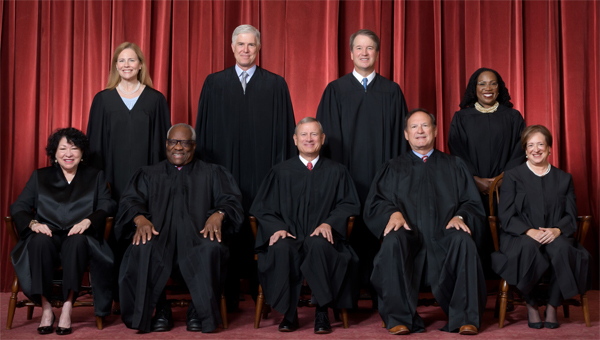
Ironically, I doubt the practical outcome would have changed very much. FERC ultimately did an excellent job drafting Order 636, and the compromise produced a sound result for the country.
But the constitutional foundation would have been entirely different.
When I wrote Part 1 of this series, I suggested that the Roberts Court is engaged in a larger constitutional project. Looking back on my own experience, I believe that conclusion even more strongly today.
Overruling Humphrey’s Executor is not simply another case about presidential power. It fits alongside the end of Chevron, the Major Questions Doctrine, the limits on nationwide injunctions, and the Court’s recent immigration decisions. Each reflects the same underlying principle: restoring clearer constitutional lines of authority and responsibility.
Constitutional law often appears to evolve through dramatic Supreme Court opinions. In reality, the constitutional questions are debated for years—sometimes decades—inside conference rooms throughout Washington, where public officials are trying to determine what the Constitution allows them to do.
In 1991, I happened to witness one of those debates.
Thirty-five years later, the Supreme Court finally gave its answer.
About the author: Ken Malloy is a retired energy policy lawyer and former federal regulatory strategist who has spent the last several years working to improve K–12 education governance in Oklahoma. He writes on civic accountability, institutional reform, and the responsibilities of self-government. He can be reached at ken@caem.org.