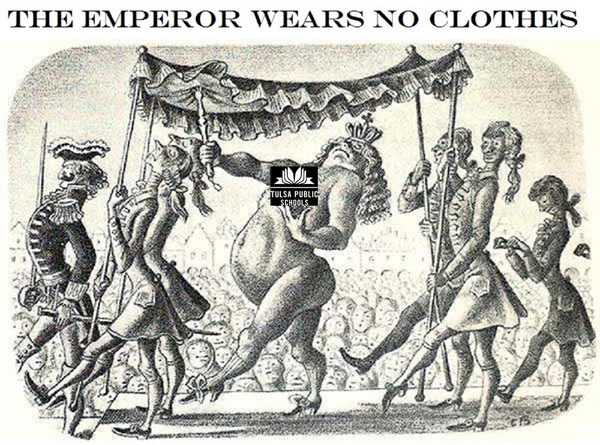
The Emperor Has No Clothes
Analysis: In Hans Christian Andersen’s famous tale, an emperor parades through town wearing magnificent clothes that do not exist. Everyone can see the truth, but nobody wants to say it. Finally, a child announces the obvious: the emperor has no clothes.
I thought about that story while listening to Tulsa Public Schools explain why it must close 17 schools, displace nearly 5,000 students, and reorganize much of the district.
We have heard plenty about budget shortfalls, inadequate state funding, school choice, declining enrollment, poverty, and the supposed academic progress being made under the current administration.
Some of these explanations contain elements of truth. But they obscure a much larger problem.
Tulsa Public Schools is an institution that has consistently failed to produce acceptable academic outcomes for the children entrusted to it.
And almost nobody in authority seems willing to confront that fact directly.
Consider the district’s academic performance. The most recent proficiency figures on the Oklahoma State Report Card indicate that only about 16% of TPS students are proficient in English language arts. That means roughly five out of six students are not meeting the state’s proficiency standard.
We can argue about testing methodology, changing cut scores, and whether proficiency is the perfect measure of educational achievement. It isn’t. But nobody should pretend these results describe a successful educational institution.
Yet rather than begin with that fundamental failure, TPS offers a collection of explanations for its financial difficulties. Let’s examine them.
Excuse No. 1: The State Doesn’t Give Us Enough Money
Oklahoma’s school funding is a legitimate subject for debate. But how much money would be enough?
Tulsa Public Schools manages a financial enterprise with annual budgeted revenues exceeding $800 million. Yet the district continues to produce deeply disappointing academic outcomes. Just using that figure as a rough approximation that would mean that for the 33,000 students TPS will be spending close to $25,000 per student.
Has TPS demonstrated that its poor academic outcomes are principally attributable to inadequate funding? Has it shown that similarly situated districts spending comparable amounts achieve equally poor results?
More importantly, has TPS demonstrated what additional funding would accomplish, how it would be spent, and what measurable improvements taxpayers should expect?
Without those answers, inadequate funding is an assertion, not an adequate explanation. Money matters. But so do management, instructional quality, institutional organization, and accountability.
In more than 40 years of analyzing government agencies, I have never encountered one that attributed its failures to poor management when insufficient funding was available as an explanation. The remarkable thing about government is that no matter how much money an agency receives, the amount necessary to succeed is invariably just a little bit more.
Excuse No. 2: School Choice Is Hurting Us
This argument may be the most revealing of all. TPS complains that charter schools, private schools, and other educational alternatives are drawing students and resources away from traditional public schools.
Certainly, when students leave, enrollment-based revenue declines. That creates genuine financial pressures, especially when a district continues operating buildings designed for a much larger student population.
But there is another question. Why are families leaving?
Some families choose alternatives for religious instruction, specialized programs, convenience, or personal preference. Others may be dissatisfied with academic performance, discipline, safety, or district leadership.
We should determine how many students fall into each category before assigning blame.
TPS enrollment has been declining for years, long before Oklahoma’s newest school-choice programs were introduced.
Could some of that decline reflect families making perfectly rational decisions about their children’s education? If a business loses customers, management does not ordinarily solve the problem by complaining that customers have alternatives. It asks why customers are leaving and what must change to bring them back.
Public education is not an ordinary business. It has obligations that private institutions do not. But that does not eliminate the obligation to examine why families are choosing to leave.
Excuse No. 3: We Have a $12 Million Budget Shortfall
This is the explanation that apparently justified closing 17 schools. But a budget shortfall is not an explanation of how an institution arrived at its present condition. It is a description of that condition.
TPS has experienced declining enrollment for many years. Its buildings, staffing arrangements, and administrative structure were developed to serve a larger student population.
As enrollment declines, revenue generally follows. Buildings and other fixed costs do not automatically decline with it.
None of this should have come as a surprise. The relevant questions are straightforward.
When did TPS leadership recognize that its operating structure was financially unsustainable? What corrective measures did it consider? What actions did it take? Why did those actions prove insufficient?
The district estimates that closing 17 schools will eventually save approximately $11.1 million, supplemented by reductions in central-office spending. That is about 1.4% of an $800 million budget.
Perhaps some consolidation is necessary. Maintaining half-empty buildings indefinitely makes little sense.
But closing schools is a financial restructuring exercise. It is not, by itself, an academic improvement strategy.
Excuse No. 4: Poverty and Demographics Explain Our Problems
Poverty presents real educational challenges. Students may arrive at school with disadvantages involving nutrition, housing stability, language, family circumstances, and access to educational resources.
Those challenges deserve serious attention. But poverty cannot become an all-purpose explanation that relieves an educational institution of responsibility for its results.
The proper question is how TPS performs compared with other schools serving similarly disadvantaged students. We should identify schools that succeed with comparable populations, examine what they do differently, and determine whether their practices can be replicated.
Similarly, declining birth rates may explain some enrollment losses. They cannot explain everything without an examination of population changes, migration, and parental choices.
Demographics are circumstances an institution must confront. They are not substitutes for a strategy.
Excuse No. 5: We’re Making Academic Progress
Superintendent Ebony Johnson has emphasized improving academic results, attendance, and other indicators. Those improvements should be acknowledged wherever the evidence supports them.
But we must distinguish between improvement and acceptable performance.
A school district moving from extremely poor results to somewhat less poor results may be improving. That does not mean it is succeeding.
Furthermore, Oklahoma’s changes in assessment standards complicate comparisons across years. Claims of substantial improvement require careful examination of whether the measurements are genuinely comparable.
The public deserves to know not simply whether scores have increased, but how many students can actually read, write, and perform mathematics at grade level.
That is the outcome that matters.
The Real Problem: Nobody Owns the Results
Here is what troubles me most. TPS has a school board, superintendent, central administration, principals, teachers, consultants, strategic plans, budgets, and an elaborate organizational structure.
But who is personally and institutionally accountable for the district’s persistently poor academic outcomes?
When student achievement remains unacceptable year after year, what happens?
Who must explain the failure? Who must produce a corrective plan? What measurable results must that plan achieve? And what happens if those results never materialize?
These questions are not answered by another strategic plan, another consultant’s report, or another administrative reorganization.
They require a system of accountability that connects authority, responsibility, measurable outcomes, and consequences.
That is the fundamental institutional failure we should be discussing.
Consider what has happened in Houston. In 2023, Texas took over the Houston Independent School District and appointed Mike Miles as superintendent. It has been a difficult and highly controversial undertaking, marked by teacher turnover, parental opposition, and serious disputes over his management methods.
But three years later, the academic results deserve attention.
- The number of schools receiving A or B ratings has increased from 93 to 205, while the number rated D or F has fallen from 120 to just 13.
- At schools operating under Miles’s New Education System, the percentage of students meeting grade-level expectations in Algebra I rose from 20% to 63%.
- Houston now meets or exceeds statewide performance on 13 of 20 state assessments, compared with none in 2023.
These results do not settle every question about Miles’s methods, and some improvements in school ratings have been challenged. But they demonstrate that substantial academic improvement is possible within three years, even in a large urban district serving disadvantaged students. The question for Tulsa is what comparable improvements its own leadership intends to produce.

The school board has now voted to close 17 schools. Families will be disrupted. Teachers will be reassigned. Neighborhoods will lose institutions that have served them for generations.
Perhaps some of those decisions are financially justified.
But after the buildings are closed, the students reassigned, and the budgets balanced, what will have changed about the fundamental ability of Tulsa Public Schools to educate children?
Will more students read proficiently? Will more master mathematics? Will the district establish measurable academic expectations and hold its leadership accountable for meeting them?
Or will we simply have a smaller version of the same institution, producing essentially the same disappointing results?
Tulsa’s educational crisis is not simply a shortage of money, an excess of school choice, or a collection of half-empty buildings. It is a crisis of institutional performance and accountability.
Until we confront that problem, the excuses will continue, the reorganizations will continue, and another generation of children will pay the price. Someone needs to say what everyone should already recognize.
The emperor has no clothes.